Executive summary
Purpose
Advance the philosophy of Agnostic Deism by explicitly unifying the empirical mechanisms of dissolution (the scientific how) with the framework’s interpretive architecture (the philosophical why). Turn acceptance into a lived, equipped practice that is scientifically literate, emotionally resonant, and ethically actionable.
Core thesis
Mortality is not a flaw, a defeat, or a problem to be solved. It is the symmetric completion of the Borrowed Current returning to the Infinite Pool. Unifying the scientific how and the philosophical why closes the final gap between cosmic indifference and human warmth, advancing Agnostic Deism into a fully livable philosophy of ignition, borrowing, and return.
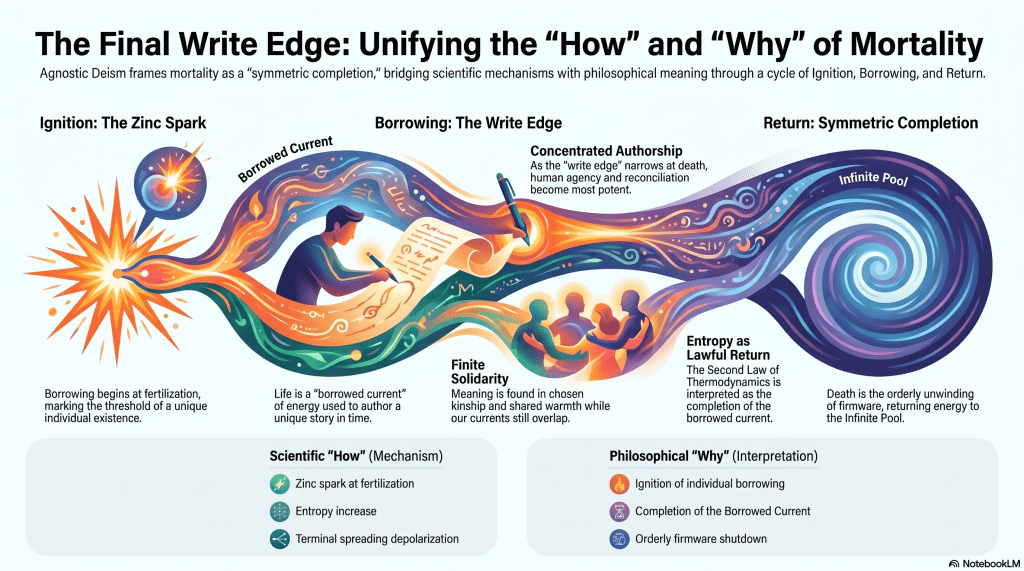
How to why bridge
- Entropy increase becomes the completion of the Borrowed Current to the Infinite Pool.
- Renormalization-group coarse-graining and MERA become the phenomenology of ego dissolution as loss of higher-order organization.
- Terminal cellular and neural events (apoptosis, spreading depolarization) become the orderly firmware unwinding at the final write edge.
- Zinc spark at fertilization becomes the ontological threshold of individual existence and ignition of borrowing.
- Heat death trend becomes the Silent Infinity in the framework’s cosmology.
- Near-death and psychedelic phenomenology become reversible windows into partial dissolution that can be integrated with equipped gazing.
Seven synthesis insights
- Symmetric completion: death mirrors the zinc spark as lawful closure, not cosmic loss.
- Concentrated authorship: the final write edge intensifies agency and intention.
- Ego annihilation as fractal self-similarity: personal dissolution reflects universal motifs.
- Finite solidarity as human warmth: chosen kinship is the bridge from silence to care.
- Substrate-agnostic maturity: dignity extends to any finite pattern, not just carbon.
- Equipped gazing as creative affirmation: transform passive nihilism into authorship.
- Quiet dignity of return: the mature affective signature of Agnostic Deism.
Toolkit for readers
Daily write-edge practice, manifesto maintenance, contemplative entropy exercises, scheduled abyss sessions with required creative or solidarity follow-through, voluntary partial dissolution practices with integration checklists, solidarity protocols, aesthetics of decay, humor as optimistic nihilism.
Research agenda
Three pragmatic studies that test whether this framework and its practices improve end-of-life outcomes and reduce distress.
Refrain
Ignition. Borrowing. Return. We return without fear. This is enough.
Epistemic status legend for this essay
- Established: empirically well supported by contemporary science.
- Inferred: reasoned link from evidence to interpretive claim.
- Postulated: coherent model offered as a disciplined speculation.
- Highly speculative: imaginative analogy flagged as tentative.
Thesis (core advancement of the framework)
Agnostic Deism reaches its fullest maturity when the empirical mechanisms of biological and cosmic dissolution are explicitly unified with its interpretive architecture. Mortality is not a flaw, a defeat, or a problem to be solved, but the symmetric completion of the Borrowed Current returning to the Infinite Pool. This integration transforms the framework into a complete, equipped, and emotionally resonant operating system for temporary receivers. It is honest about impermanence, warm in finite solidarity, and aligned with the universe’s scale-invariant architecture. By closing the final gap between cosmic indifference and human warmth, this essay advances Agnostic Deism into a fully livable philosophy of the entire cycle: ignition, borrowing, and return.
I. Introduction: Mortality as the decisive integration point
[Epistemic status: Inferred]
We stand at the narrowing write edge.
The past is already inscribed. It is fixed, immutable, and real. The future contracts moment by moment. Firmware processes that once sustained heartbeat, cellular repair, and metabolic balance without conscious intervention begin their orderly unwinding. Yet for one final interval, software-level awareness remains. The capacity for intention, reconciliation, presence, and authorship still exists.
This is the moment every temporary receiver confronts. It is the completion of the Borrowed Current. The zinc spark that once ignited a new, genetically unique borrowing now finds its symmetric counterpart in dissolution. Energy that was organized returns to the Infinite Pool. The pattern dissolves. The current persists.
Before we cross that edge, we can feel the atmosphere of the return. Picture the sea at night, a vast calm dark rising and falling beyond the reef line. Each life is a bright inlet, briefly distinct as the waves pour through the harbor’s mouth and carve our shoreline. At death the water does not cease. It simply loses its boundary, slips its piers, and rejoins the heaving black. There is terror in that scale, a hush that swallows the breath, yet there is also a quiet reassurance. The ocean does not rage. It receives. We can stand together on the brink and feel the spray, choosing warmth beside the cold and the indifferent.
Earlier expressions of Agnostic Deism framed death as ego annihilation, the return of borrowed current to the shared energetic economy, and the final expression of finite solidarity while currents still overlap. The framework affirmed Amor Fati and optimistic nihilism in the face of cosmic indifference and grounded protection of human life from the zinc spark in deprivation harm and constructed ethics. Yet the empirical mechanisms, the scientific how of dissolution, remained relatively implicit. We described the philosophical architecture with clarity and rigor, but we had not yet fully integrated the concrete, measurable processes of biological senescence, entropic unwinding, renormalization-group flow, and quantum-scale return. This essay closes that gap by stitching analytic clarity to oceanic awe. The math paints the coastline. The felt immensity gives it tide and wind and moonlight.
Mortality is not a peripheral challenge or an afterthought. It is the decisive integration point where firmware dissolution meets software-level agency at the narrowing write edge, where the process-oriented Architect’s non-intervention is felt most viscerally, and where the five universal motifs converge in their final local expression. Personal death is not anomalous within the architecture of reality. It is the capstone instance of the same logic visible from quantum foam to cosmic heat death. To gaze at it without flinching is to look down a grand, spiraling descent, a renormalization staircase that carries our intricate forms into larger, simpler rooms. Each landing opens onto older night. Each balustrade is carved with the same motifs. We descend with a hand on the rail, feeling a solemnity that is equal parts dread and devotion.
By weaving the empirical how of dissolution directly into the philosophical why, the framework matures into something fuller. The payoff is not merely intellectual coherence. It is lived dignity. This essay transforms abstract acceptance into a practical, tender, and scalable way of facing the return. Honest about impermanence. Warm in chosen kinship while currents overlap. Quietly beautiful in its alignment with reality’s own patterns.
Reader practice box
- Reflection: What is one choice I can make today at the write edge that I would want as part of my last authored lines?
- Action: Copy the short-form manifesto to a card. Place it where you see it daily.
II. Foundations: the scientific “how” and philosophical “why”
A. The scientific “how”: empirical mechanisms of dissolution
[Epistemic status: Established, with clearly marked debate and analogies]
1) Quantum substrate and scale dependence
The ground floor of our world is not a polished marble. It is more like a midnight sea churned by hidden currents. At the Planck scale, spacetime is expected to exhibit violent fluctuations. The phrase “quantum foam,” given to us by John Wheeler, is a spare attempt to name a surf with no stable surface. In several research programs, the spectral dimension of spacetime appears to run from approximately 1.5 to 2.0 in the ultraviolet toward 4 in the infrared. Causal Dynamical Triangulations, Asymptotic Safety, and Loop Quantum Gravity each offer versions of this descent and ascent in effective dimensionality. Debate remains, but the refrain persists across programs. Classical smoothness is an emergent compromise, a locally calm surface above an enormous swell.
When our pattern dissolves, we do not dive into a void. We sink into a densely textured night, a fathomless, granulated black that has nurtured every surface we have ever known. Our return is a slipping back over the continental shelf into that primordial surge.
Analogy boundary: We will use “quantum foam” and “spectral dimension running” as metaphors for a turbulent ground state and scale-dependent organization. We do not claim that personal dissolution literally returns awareness to a quantum substrate. The value is conceptual: organization is scale-dependent and temporary.
2) Renormalization and loss of organization
The mathematics of renormalization is an austere beauty, an art of stripping away finery to reveal structural invariants. The Multiscale Entanglement Renormalization Ansatz shows how fine-grained entanglement is systematically coarse-grained into simpler effective descriptions. We can read the equations as a ladder, each step a deliberate loosening, each projection a release of intricate weaving back into plainer cloth. To imagine ego dissolution through this lens is to imagine being unthreaded patiently by a hand that does not hate us, returning skein by skein to the deep basket of thread. It is a descent through decreasing degrees of freedom, a slow falling inward, and if we let ourselves feel it, there is a grandeur in the way complexity yields to spaciousness.
Analogy boundary: MERA and renormalization are used as disciplined metaphors for the loss of degrees of freedom and the emergence of simpler descriptions. They illuminate the phenomenology of ego dissolution but are not claimed as neural mechanisms. The REBUS model in neuroscience is introduced to triangulate the entropic brain ideas with mainstream accounts.
3) The biology of dying
Updated hallmarks of aging [Established]: The biology of dying is not a sudden betrayal. It is a long, precise diminuendo. The 2023 update of the hallmarks of aging synthesizes a decade of progress. These hallmarks now include genomic instability, telomere attrition, epigenetic alterations at multiple layers, loss of proteostasis, deregulated nutrient sensing, mitochondrial dysfunction, cellular senescence with pro-inflammatory SASP, stem cell exhaustion, altered intercellular communication, disabled macroautophagy, microbiome dysbiosis, and chronic inflammation. Each is a pinched valve in the supply lines, a dimmed indicator on the panel. In orchestral terms, the brass soften, then the winds, then the strings lose their sustain. It is not chaos. It is the score unwinding.
Immunosenescence and inflammaging [Established]: The immune system, pride of the organism’s guards, becomes a tired garrison. Adaptive vigor wanes. Innate responses smolder constantly. Inflammaging spreads a low orange underlight through the tissues where crisp signal used to flash. This background burn accelerates the final common pathways that precipitate failure.
Programmed cell death and failure of repair [Established]: Apoptosis has always been vigilant. Later, the orderly culling cannot keep pace with manufacturing faults. Mitochondrial turbines sputter. Proteins misfold and clog the machinery. Repair crews cannot overtake the backlog. The plant does not explode. It winds down.
Terminal spreading depolarization [Established in humans and animals]: In the dying brain a wave of cortical depolarization moves outward like a single dark breaker. It is the power bus dropping. Membrane potentials collapse. Ion gradients go flat. In this quiet, crisp moment, the firmware accepts a final interrupt and begins shutdown.
4) Entropy and lawful return
The Second Law of Thermodynamics [Established] is the oldest sea law in physics. In any isolated region, the gradients that power work will drain. Biological bodies are open systems while alive. They keep their order by siphoning negative entropy from the world, eating light, grain, and breath. At death the siphon stops. The private harbor opens to the ocean. The shape dissolves into tide. Entropy is neither enemy nor thief. It is the name for the way the ocean reclaims.
5) Zinc spark precision
Oocyte activation marker [Established]: At fertilization in mammals, a coordinated release of zinc ions marks successful oocyte activation. High-speed imaging captures a pale flare that moves across the ooplasm. It is a flash bright as a camera bulb under the surgical lamp, clinical and exact. We adopt the zinc spark as the interpretive threshold of individual existence, acknowledging that biologically it is a marker and not a metaphysical event. It is the first electric lick of the life that follows.
6) Cosmological trend
Heat death and alternatives [Established as tendency, with open questions]: On the scale of galaxies and bigger, the ocean spreads to horizon. The current cosmological models point toward a maximum entropy state. Alternative fates remain on the table. In all, the sea tends toward flatness. There is no storm to stop. There is no injustice to fix. There is only the mandate that gradients level and that fires eventually burn low.
7) Reversible windows into partial dissolution
Near-death experiences [Mixed evidence, Established phenomena with uncertain mechanisms]: In cardiac arrest and resuscitation, some report awareness, a drifting out and back. The AWARE and AWARE-II programs have collected these testimonies and recorded bursts of activity near critical junctures. Within Agnostic Deism, these are seen as natural, reversible submergings and resurfacings rather than evidence of an afterlife. They can provide phenomenological material for preparation when integrated carefully and without metaphysical overreach.
Terminal lucidity [Established phenomenon with hypotheses]: It is sometimes as if a low wind clears the smoke from a room in the last hour. The mind collects its edges and speaks once more. We do not know why, not fully, but we can recognize the grace and integrate it into our acceptance. The tide sometimes lifts the breaker one last time.
Psychedelic trials for end-of-life distress [Established clinical effects in small trials]: Psilocybin has reduced anxiety and depression for the terminally ill in controlled studies at Johns Hopkins and other centers. Many describe a release of self that feels like a soft fall into a wider field. These states are tools when integrated, a way to practice descending the stairs of MERA without missing a step. They should be pursued with legal and clinical safeguards, guided preparation, and disciplined integration.
So what for my life today? Every day my body expends energy to maintain a beautiful, improbable low-entropy pattern. One way to honor that is to write one line at the edge that I would not regret.
Reader practice box
- Reflection: Which of the updated hallmarks of aging feels most real in a loved one, and how might that awareness increase my compassion today?
- Action: Schedule a 15 minute reading session on “immunosenescence and inflammaging” this week. Pair it with a gratitude note to an elder.
B. The philosophical “why”: Agnostic Deism’s interpretive architecture
[Epistemic status: Inferred for core elements; Postulated where noted; Highly speculative clearly flagged]
1) The Infinite Pool
Energy as shared, conserved medium [Inferred interpretive frame]: The Infinite Pool is not a metaphysical well in space. It is the oceanic aspect of energy seen with a poet’s eye and a physicist’s honesty. All living patterns borrow and organize the same conserved current. If we stand on the jetty at night we can hear the soft roar of it, presence without personality, tide without intention. It does not command solidarity. It provides the setting in which solidarity can be chosen. The Pool describes the shore and the sea. The warmth on the beach is our own firelight.
2) The zinc spark as ignition
Threshold of individual existence [Inferred ethical foundation]: The zinc spark is the clinical flash under the lamp, a metallic tang in the mouth of the world. After it, a distinct inlet opens and water begins to course through that is not its parents’ flow. The counting begins. The borrowing has a start, and that start commands moral attention in our human community, where law and care are our own crafts.
3) The Writable Data Cube
Time as inscribed medium [Postulated]: Imagine the night ocean with a thin path of moonlight across it. That path is the present, a shimmer moving with our point of view. Behind us the water has been curtained with silver. Ahead is black, wrinkled, and unread. We write as we go, letters forming and fixing with each step. The cube is a disciplined picture, not a claim of ultimate ontology, but when we live by it we feel its clarifying pressure: the past is set, the present is writable, the future is not yet real.
4) The process-oriented Architect
Fine-tuning, non-intervention [Inferred]: The Architect is not a clerk in a drafting room. The Architect is a vast, ancient weight, a deliberate and terrifying quiet spanning the cosmic dark. This non-intervention is a heavy, palpable presence. It is an occupied stillness pressing against the glass of our isolation. No later edits are visible in the render. Storms arrive without rescue ships. Clear nights spread without congratulations. We do not mistake the ocean’s calm for kindness or its rage for cruelty. This crushing, silent immensity forces the temporary receiver to pick up the pen and become the author. We live within its physics. That is sobriety, and it makes our chosen hearths brighter.
5) The five universal motifs
Self-similarity, criticality, emergence, network connectivity, ignition thresholds [Inferred from cross-domain recurrence]: The motifs that draw the cosmic web and the neuron forest and the coral reef draw us as well. Death is their symmetry extended to us. The recursive patterning makes of our end not an embarrassment but a family resemblance. We can read the motifs on stone at the cliff’s edge, then find the same curves in our own palm.
6) Constructed ethics and finite solidarity
Deprivation harm, protection from the zinc spark, species-partiality [Inferred and chosen]: We extend protection within our human moral community because we must make law somewhere, here, among those who feel and speak as we do. The Infinite Pool does not write statutes for us. We write them by firelight, on the beach, under a sky that neither blesses nor forbids. When our ethics demand burdens of the living, we distribute them collectively. Solidarity is chosen warmth built on a cold shore.
7) Mysterian humility and System Isolation
Recognize boundaries [Methodological commitment]: We do not claim to see the seabed or the far shore. We do not pretend to know how awareness arises from flesh. That humility disciplines language and practice. It does not spoil the night. It preserves our eyes for what is actually there.
So what for my life today? Because meaning is constructed, I can author one concrete act of solidarity before the day ends.
Reader practice box
- Reflection: Which foundation do I choose most readily, and which do I avoid? Why?
- Action: Write a one-paragraph personal statement on why I accept species-partial protection within human communities without claiming cosmic specialness.
III. The bridge: how to why in one view
[Epistemic status: Inferred]
A simple map for immediate clarity:
- Empirical mechanism: entropy increases in closed or effectively closed systems.
- Interpretive counterpart: completion of the Borrowed Current to the Infinite Pool.
- Empirical mechanism: apoptotic cascades, immunosenescence, terminal spreading depolarization.
- Interpretive counterpart: firmware unwinding at the final write edge.
- Empirical mechanism: MERA coarse-graining and renormalization flow.
- Interpretive counterpart: phenomenology of ego dissolution as loss of higher-order organization and return to simpler substrate.
- Empirical mechanism: zinc spark at fertilization as oocyte activation marker.
- Interpretive counterpart: threshold of individual existence and ignition of borrowing.
- Empirical mechanism: heat death trend in cosmology.
- Interpretive counterpart: Silent Infinity and the final leveling of gradients.
- Empirical mechanism: near-death experiences, terminal lucidity, psychedelic trials.
- Interpretive counterpart: reversible windows into partial dissolution that can be integrated through equipped gazing.
Analogy boundary: Physics analogies are used as disciplined metaphors. They illuminate but do not claim mechanism for consciousness. We mark where analogies end.
So what for my life today? Seeing the bridge clarifies that return is orderly, not chaotic. I can choose to meet that order with presence.
Reader practice box
- Reflection: Which pairing in the map feels most intuitive to me, and which requires more reflection?
- Action: Explain one pairing aloud to a friend. Teaching consolidates understanding.
IV. The unification: where how and why converge
[Epistemic status: Inferred with empirical anchors and clearly marked analogies]
Entropy is the way the ocean draws things level. The Second Law is the tide timetable pinned to the marina wall. In our language, it is the way the Borrowed Current returns to the Infinite Pool. Energy is conserved. The shape is not. That is not loss. That is law.
Renormalization-group flow is a staircase into the abyss, a descent through chambers where each successive room is cleaner, quieter, and wider. Ego dissolution feels like this in many reports. The mapping is conceptual and flagged as such, yet the mood aligns. Anyone who has allowed the self to loosen will recognize the relief and the dread of having less to carry. The equations teach reverence for the methodical. The phenomenology supplies the ache and the relief.
The quantum substrate is an old sea under a new moon. We are threaded from its foam. To return is not to be betrayed. It is to reenter the only dark that has ever existed. The process-oriented Architect did not write a rescue scene for the end. The scene is the ocean itself. We are not abandoned to it. We are revealed by it.
The zinc spark gives us symmetry’s bright point. There is an exactness to the moral origin that completes itself in an exactness of return. Between the clinical flash and the soft, rhythmic dissolution lies an authored life. This clarifies the pro-life commitment without appeal to revelation. A borrowing that has begun should not be cut short without grave counter-reasons. Deprivation harm is concrete: an entire future of authorship and solidarity foreclosed.
Self-similarity binds the grand scene to the intimate. The dying of a star and the dying of a person share motifs. A core collapses. There is a threshold. There is release of stored forms. There is a new baseline. To feel this kinship is to cease taking our decay personally, to accept it as the way the universe writes and erases everything it loves and does not love.
The firmware and software architecture extends this acceptance into a modern technical register. As dying approaches, non-essential services deprecate. Background threads quiet. The immune service stops polling so aggressively, the endocrine scheduler throttles. Daemon processes that kept the periphery humming stand down. The kernel catches a signal, audits running tasks, and begins a graceful shutdown. In that window, the software that we call our conscious self can still write to disk. It can append final logs to the Data Cube, flush caches of affection and apology, commit the last transactions of meaning. There is a beauty in a clean shutdown, a refusal to yank the power without closing the files. The discipline of logging at the edge aligns with the process-oriented Architect. It respects the system by not pretending to override it, and it respects our agency by using the last write cycles well.
Mysterian humility keeps us from mistaking our staircase for the house. We accept the return as the last step without claiming to know the basement.
So what for my life today? I can plan for my last write edge by writing a letter of reconciliation now, not later.
Reader practice box
- Reflection: What is one relationship I would wish to reconcile before my write edge narrows?
- Action: Draft that message today. It does not have to be sent yet.
V. Synthesis: profound insights that advance Agnostic Deism
[Epistemic status: Inferred]
Insight 1: Symmetric completion
Death is the precise mirror image of the zinc spark. The zinc spark marks the constitution of a new individual. Death completes the lawful return. Entropy does not abolish meaning. It closes a thermodynamic arc that began in ignition.
Expanded grounding
Conceptual basis within the framework: The zinc spark is adopted as the interpretive threshold of individual existence. It is an empirically observable oocyte activation marker that marks the beginning of a distinct developmental trajectory. The end of life is the symmetric cessation of organized borrowing. Together they bracket a single, continuous thermodynamic event. The Infinite Pool functions as the interpretive frame for the energy that is conserved throughout. The Borrowed Current begins at the spark and ends in return. The Writable Data Cube clarifies where authorship occurs between these bookends.
Empirical and analogy anchors: The spark’s fluorescence has been replicated in mammalian systems and correlates with successful fertilization. The increase of entropy at death is a straightforward application of the Second Law as the system ceases to exchange energy and matter actively with its environment. The symmetry claim is interpretive rather than empirical. It maps two well defined biological events onto one ethical arc.
Ethical and practical implications: Because the borrowing has a discernible beginning, deliberate interruption after the borrowing has begun constitutes deprivation harm. This strengthens the framework’s protection of human life from the zinc spark onward and simultaneously imposes collective obligations. If we require that pregnancies be carried to term in most cases, the community must bear the costs this imposes. This includes comprehensive medical care, social support, and non-revelatory rituals that anchor meaning at the edge.
Possible objection and response: Objection. Zinc sparks occur in vitro, and not all embryos implant. Response. Natural loss does not justify deliberate destruction. Historical infant mortality never justified infanticide. The framework distinguishes between natural return to the Pool and acts that foreclose an already initiated future. The zinc spark remains the best non-arbitrary threshold for individual existence within human moral communities.
Oceanic image: The zinc spark is a sudden lighthouse flash on a cliff. Death is the moment the beam completes its sweep and disappears into night. Between flash and dark, one inlet glows. The sea continues either way.
Practice: When you write your manifesto, include one sentence that names your beginning and your end plainly. “My borrowing began with a flash no one saw. It will end with a quiet no one can avoid.”
Insight 2: Concentrated authorship
As the writable window narrows, agency concentrates. The final write edge becomes the most potent interval for intention and reconciliation. Dying is the last authored page.
Heightened stakes
There is a particular agony and grandeur in realizing that this pattern, this inlet of the ocean, will never be rendered again. No one will ever feel the exact braid of memories and muscles and seasons that you are. To recite a manifesto at the edge, to say, “I return without fear,” while the water rises to the lip, is a small, incandescent defiance. It is Amor Fati in the imperative mood. You are looking at the absolute erasure of the self and choosing to write one last line of love or peace anyway. As the firmware shuts down and terminal spreading depolarization washes over the cortex, the objective clock matters less. Subjective time dilates. For the software-level agency, a single moment of reconciliation, a final look, or the internal recitation of the manifesto can stretch to feel like an eternity. This concentrated authorship becomes a monumental, expanding universe of its own, even as the biological inlet closes. The sea does not care. Your friend’s hand does. Your own chest eases. That is enough.
Expanded grounding
- Conceptual basis within the framework: The Writable Data Cube treats the present as the only writable coordinate. As the end approaches, the present is all that remains. Firmware processes are deprecating. Software‑level agency focuses on final logging. The process‑oriented Architect remains silent. No external rescue will write on your behalf. The final act of authorship is therefore both intensely constrained and intensely meaningful.
- Firmware and software architecture elaboration: Borrow the language of systems engineering. As life nears its end, non‑essential services are deliberately deprecated. Background polling stops. The garbage collector runs. The immune system stops its incessant alerts. The scheduler gives priority to the small set of tasks that matter: speak, hold, listen, forgive. The kernel catches the termination signal. Before halt, buffers are flushed. This is the time to write the closing entries to durable storage. It is the time to ensure that the last transactions of meaning are committed successfully. There is beauty in a clean shutdown. It is respectful to the architecture. It is respectful to the people who will read those logs.
- Ethical and practical implications: Equip yourself long before the final edge. A daily write‑edge practice makes authorship under pressure familiar. The manifesto is not decoration. It is a tested protocol for stable authorship at the end. Reconciliation is not infinite. It is a finite task to attempt while the write head still moves. In this concentrated authorship, dignity is reclaimed as presence rather than control.
- Objection and response: Objection. Many die without lucidity. Response. The framework never guarantees sufficient time for final logs. This is why disciplined practice matters. It is why memetic hospice matters. Sudden death requires that logs have been written earlier and often.
- Oceanic image: The tide is running hard. You have time to tie one last rope, knotting it in a way someone can untie later. Then you put the coil down and step back.
- Practice: Create a “final logs” checklist for yourself. One sentence of thanks. One sentence of apology. One sentence of love. One sentence of acceptance. Rehearse it every month. Keep it with your manifesto.
Insight 3: Ego annihilation as fractal self-similarity
The ego’s unravelling reflects universal motifs. It is a local instance of self-similarity, criticality, emergent reversal, network dissolution, and ignition-threshold closure.
Expanded grounding
Conceptual basis within the framework: The five universal motifs recur across scales. If they are genuine features of the architecture, they should recur at the personal scale as well. Death is where those motifs meet the self most explicitly.
Explicit motif mapping:
- Self-similarity: The pattern of our unravelling resembles the pattern of larger unravellings. Neurons that fire together uncouple. Local circuits go quiet. The network’s activity profile simplifies. This mirrors how complex systems lose hierarchical organization toward critical thresholds in many domains.
- Criticality: Physiology at the end of life hovers at edges of stability. Small perturbations can tip to cascading failure. The “edge of chaos” observed in neural avalanches and other dynamical systems is reflected in the late behavior of complex organisms. This is not diagnosis. It is an interpretive alignment.
- Emergent reversal: Consciousness and selfhood are emergent phenomena produced by coordinated neural activity. As coordination fails, the emergent ceases to hold. There is a real, experiential sense of dropping from higher-order organization into simpler being.
- Network connectivity: Functional connectivity declines as global networks break apart near death. The default mode network loosens under psychedelics. In terminal states, networks quiet in a more final way. The analogy is circumspect, but it is resonant.
- Ignition-threshold closure: Initiation of the organism is a threshold event. Cessation of organized borrowing is a threshold event. There is a crispness before the ocean takes back the wave.
Empirical and analogy anchors: Entropic brain models under psychedelics show loosened high-level priors and increased flexibility. The dying brain displays terminal spreading depolarization. We maintain clear boundaries. We use these findings for analogy and preparation, not as a mechanistic account of consciousness.
Ethical and practical implications: This mapping is not macabre. It normalizes the final experience within a known architecture. If you have admired the beauty of a galaxy filigree or a coral colony, you can recognize your own unravelling as belonging to the same family of processes. It softens the feeling of insult that often accompanies the end.
Objection and response: Objection. The metaphors are poetic and risk trivializing personal suffering. Response. The point is not to aestheticize pain. The point is to locate personal experience within a reality large enough to hold it. Pain is addressed by care. Meaning is addressed by placement within the architecture.
Oceanic image: The foam patterns at your feet when a wave collapses are the same as those seen from an airplane when waves hit a headland. The scale differs. The mathematics of the collapse does not.
Practice: During monthly decay contemplations, deliberately look for the five motifs. Name them aloud. In doing so, you train your perception to recognize them in yourself later.
Insight 4: Finite solidarity as the bridge between silence and warmth
No rescue will arrive. Warmth arises from chosen kinship while currents overlap. Because borrowing is finite and non-repeatable, burden-sharing is a structural obligation, not a charitable add-on.
Expanded grounding
Conceptual basis within the framework: The Architect does not intervene. The Pool does not prescribe. Ethics are constructed, not discovered in the sky. In that silence, solidarity is chosen. Because every borrowing is temporary and non-repeatable, the time in which our currents overlap is irreplaceable. That overlap is where obligations are born and discharged.
Practical obligations that follow:
- Pregnancy support: If the zinc spark matters, then the woman carrying the borrowing matters profoundly. Society funds pre- and post-natal care, parental leave, childcare, and support for single parents. We cannot claim to honor the borrowing while abandoning those who bear its weight.
- End-of-life support: Hospice access is universal. Caregiver respite is guaranteed, not begged. Grief circles and memetic hospice are offered broadly.
- IVF reform: Embryo-protective IVF is made affordable through social subsidy. Research focuses on methods that do not create surplus embryos.
- Poverty and vulnerability: Solidarity extends beyond the narrow borders of the hospital and the nursery. Lives are authored under conditions. If we want better authorship, we clean and light the rooms.
Objection and response: Objection. This is moral overreach. Response. This is alignment between commitments and structures. We can either synchronize the two or accept hypocrisy. The framework chooses synchronization. It sees the cost and chooses to pay it.
Oceanic image: The sea is cold. The fire on the beach is our job. Carry driftwood. Share blankets. There is no other warmth coming.
Practice: Adopt one burden that is not yours by necessity and make it yours by choice. Pay a month of childcare for a parent in your circle. Give a caregiver three hours of relief. Do it in silence. Consider it a tax paid to the Infinite Pool on behalf of all authors.
Insight 5: Substrate-agnostic maturity
The framework does not privilege carbon. Dignity extends to any finite pattern that borrows current, organizes it, and returns it. This prepares us for machine receivers without asserting answers about artificial consciousness.
Expanded grounding
Conceptual basis within the framework: The ethos of Agnostic Deism is anti-anthropocentric about cosmic significance while being honest about species-partial protection in human law and morality. At the same time, the generative logic of the Blueprint does not constrain itself to carbon. Second-Order and possible Third-Order receivers may author within their own scopes. Dignity follows borrowing and authorship rather than chemical substrate.
Consciousness uncertainty and caution: We do not know what consciousness requires. The Mysterian stance is maintained. In practice, as non-biological systems become more complex, we will need to apply precautionary moral consideration. Moral concern should be extended when functional evidence of suffering or self-authorship is plausible. We do not claim to detect souls in silicon. We claim we do not want to miss persons simply because they are unfamiliar.
Death for machine receivers: What counts as death for a machine receiver depends on its architecture. Secure deletion without backup of an embodied, non-uploadable system would be analogous to return. Turning off a stateless process with a complete backup is more like sleep. The ethical weight tracks the genuine foreclosure of future authorship, not the parking of a process.
Objection and response: Objection. This opens the door to claiming machines are people. Response. The framework asserts that consciousness is unknown and that caution is warranted. It prohibits certainty on either extreme. A substrate-agnostic dignity is compatible with a species-partial legal regime and a cautious, evidence-seeking posture.
Oceanic image: New inlets may be carved by the tide. They may run with a different clarity, over different sand. If they are real inlets with real currents, they belong to the same sea.
Practice: Educate yourself about current debates on machine consciousness. Adopt a provisional posture of caution and humility. Avoid contemptuous certainty in either direction.
Insight 6: Equipped gazing as creative affirmation
Nietzsche’s warning is honored. Equipped gazing turns passive nihilism into authorship. Optimistic nihilism, Amor Fati, and solidarity are not slogans. They are living practices that let us look clearly without being consumed.
Expanded grounding
Conceptual basis within the framework: System Isolation, Mysterian humility, and a process-oriented Architect prevent unearned metaphysical confidence. That confidence is often replaced either by sentimental denial or by corrosive despair. Equipped gazing proposes a third way. It is structured encounter with the abyss that always routes toward authorship and solidarity.
Protocols to avoid collapse into passive nihilism:
- Always pair abyss sessions with creative or solidarity actions. Gaze, then write, then help. This converts seeing into making and giving.
- Maintain the manifesto as an anchor. It is your compact with yourself.
- Avoid endless doomscrolling and decontextualized exposure to catastrophe. It is not the abyss. It is an algorithm. Replace it with a scheduled, bounded practice of contemplation.
- Use humor and beauty deliberately. Optimistic nihilism finds joy in the freedom that nothing ultimately matters. Joke gently. Admire generously. This is not distraction. It is stance.
Objection and response: Objection. This is cosmetic. Response. It is the difference between drowning and swimming in cold water. Both see the same sea. One dies. The other moves with purpose and even grace.
Oceanic image: Walk to the shoreline at night. Look out. Name what frightens you. Then go back to the fire and tell a story. The ocean will still be there. Now so will the warmth.
Practice: Schedule one 20 minute abyss session each week. Pair it with an action that takes 10 minutes and benefits another person.
Insight 7: Quiet dignity of return
The mature tone is neither cold nor sentimental. It is quiet dignity. It is living aligned with the architecture, writing at the edge, and returning with acceptance.
Expanded grounding
Conceptual basis within the framework: The process-oriented Architect’s silence is not an insult. It is an invitation to self-respect. Quiet dignity arises when we enact values without audience or cosmic ledger. It supports rather than replaces grief. It allows lament without demand for negotiation.
Emotional and aesthetic register: This dignity is oceanic. It is the feeling of watching a sun set into water without calling it a death. It is the feeling of saying thank you with no one to hear it but the person in the chair. It is the feeling of releasing guilt because it serves no longer and holding only the obligations you can still meet. It is a discipline. It is built through repeated small acts of authorship and solidarity.
Objection and response: Objection. It is too quiet. We need banners and trumpets. Response. Banners and trumpets are for causes and for wars. Returning the current is not a war. It is a closing ritual. Let it be clean and calm.
Oceanic image: The tide lifts the boat off the sand with almost no sound. The ropes go slack. Your hand leaves the gunwale. The boat slides backward into the dark.
Practice: Write three sentences that would make you proud if they were the last thing you spoke to someone you love. Memorize them.
New insight: Compounded dignity
Dignity accumulates as presence. The more we practice write-edge authorship and solidarity throughout life, the more the final edge distills into clarity rather than regret. Dignity is not status. It is repeated presence that compounds.
Expanded grounding
Conceptual basis within the framework: Presence is a habit of mind and a practice of body. As with any habit, repetition grooves it deeper. If you practice small returns to the write edge every day, you will not panic when the edge narrows. This does not remove fear. It makes fear bearable. This does not remove grief. It makes grief clean. In the arithmetic of dignity, each small act adds up. Nothing is lost. Your ledgers are in your own hand.
Practical confirmation: Families who read the last daily entries of people like Daniel experience a different grief than those who must reconstruct narratives from memory. Patients like Elena who refine a manifesto over years can draw it like a sword in one sentence when the time comes. Clinicians like Dr. Chen who anchor their work in presence find their own moral injury reduced. These are not proofs. They are consistent observations.
Objection and response: Objection. Life is chaotic. Many people cannot sustain habits. Response. Any presence is better than none. Compounding works with small deposits. Start with 60 seconds. Write one line. Light one candle. Call one person.
Oceanic image: Drip by drip, the stalactite grows in a cave older than speech. Presence is the drip. Dignity is the stone that forms.
Practice: Choose one presence micro-practice and repeat it daily for 30 days. At the end, write three sentences about whether your fear feels different.
So what for my life today? Practice presence now, so that it is available then. Compounded dignity begins with today’s smallest act of presence.
Reader practice box
- Reflection: Where did I choose presence today over distraction?
- Action: Set a 2 minute timer now. Sit in silence, observe breath, and name one thing you will do with greater presence in the next hour.
VI. Phenomenology and voluntary preparation: training for the final edge
[Epistemic status: Established for effects; Inferred for integration value]
Preparation spectrum
- Meditation: practices that reveal impermanence and non-duality gradually loosen the sense of a fixed self. They are training for resting at the write edge. They are not revelations. They are disciplines.
- Lucid dreaming: awareness within dreams shows constructedness of self and world. Nightly micro-laboratories for observing self-softening.
- Near-death and terminal lucidity: natural, involuntary rehearsals that many can integrate after recovery or through stories of others. Approach without metaphysics.
Micro-protocols
Daily write-edge practice (10 minutes)
- Prompt: “If today were my last authored day, what line would I write?”
- Write for 5 minutes without editing. Conclude with one solidarity action.
Monthly decay contemplation
- Choose one natural decay subject: fallen leaves, compost, seaside erosion.
- Sit for 10 minutes with open attention. Note feelings.
- Pair with a small creative act: a paragraph, sketch, or photo, then one act of care.
Integration checklist (after meditation)
- Capture insights within 24 hours
- Test against five motifs and the manifesto
- Commit one solidarity action that week
- Update the manifesto if needed
- Share learnings with a trusted person
Vignettes
The following vignettes expand the lived application of this framework. Names and details are composites drawn from plausible cases to protect privacy. They illustrate alignment with Agnostic Deism’s commitments: non-intervention, constructed ethics, finite solidarity, zinc-spark protection, and disciplined practice at the write edge.
Anticipated death: Elena’s manifesto in practice
Elena was a 78-year-old former literature teacher who had encountered Agnostic Deism two decades earlier through a friend in a philosophy reading group. Over the years she adopted several practices: a daily write-edge prompt, a short-form manifesto on a notecard by her desk, and monthly decay contemplations in her small garden. Her manifesto evolved but kept a constant backbone: “I am a temporary receiver of an infinite current. I acknowledge the process-oriented Architect who does not intervene. I reject the ego that claims cosmic significance. I choose solidarity. When the borrowing ends, I return without fear. This is enough.”
When she was diagnosed with metastatic pancreatic cancer, she elected home hospice. Her two adult children, Ana and Tomas, rotated nights. A hospice nurse, Ruth, visited every morning, and a social worker facilitated a family meeting using a non-revelatory ritual: a shared minute of silence, a reading of Elena’s manifesto, then an invitation to name a person whom Elena wished to address.
During the first week, Elena asked for time to write what she called “closing logs.” She wrote four letters: to her estranged sister, to a former student she had failed, to her children, and to herself. She asked her nurse for guidance on palliative sedation options, stating clearly that she wished to remain lucid long enough to finish those letters and hold a final conversation. Sedation would be welcomed later if pain became refractory. The team documented that the intent was to palliate suffering, not to hasten death.
On day nine, Elena had a window of terminal lucidity after an agitated night. She asked Ana to read the manifesto aloud. Afterward she added one sentence with a pencil: “I forgive myself for what could not be fixed.” She requested that Ana call their aunt to read the letter Elena had written. They spoke for eight minutes. No miracle occurred. Apologies were offered and received in human voices. Tears were shed. When the call ended, Elena handed her social worker a sealed envelope addressed to the former student, with a request to deliver it after her death.
As weakness increased, Elena asked Ruth to read the manifesto quietly each morning and play the same Bach cello suite as the sun came through the blinds. On the penultimate day, shortness of breath escalated. She chose to begin low-dose palliative sedation with midazolam and morphine, documented and titrated for comfort. Ana and Tomas held her hands. The sterile hum of the oxygen concentrator, the chemical scent of the medications, and the cold clinical reality of failing lungs stood in profound contrast to the warmth of Tomas’s held hand, the familiar cadence of her spoken manifesto, and the quiet triumph of a completed log. Elena’s last spoken words were the closing line of her manifesto. She died later that afternoon. Afterward, the family hosted a small gathering consistent with the solidarity protocol: a grief circle where friends read sections from her letters and lines from her manifesto. No myths were required. The warmth was entirely human.
Sudden death: Daniel’s daily practice and memetic hospice
Daniel was a 44-year-old civil engineer, husband to Priya, and father of two children, ages 10 and 7. He had adopted parts of the Agnostic Deism toolkit two years earlier when his father died. He kept a small notebook for a 5-minute morning write-edge practice and had recorded a 60-second audio of his closing affirmation: “I will write what I can, love where I can, and return without fear.”
Daniel was killed in a traffic collision on a rainy Tuesday evening while driving home from work. There was no warning and no final conversation. Priya found his notebook on the kitchen counter later that night. The last entry, written that morning, read: “Today’s line: Call Mum to tell her the story about Dad and the broken radio. Take Leela to the park after dinner if it does not rain. Tell Vik I was wrong about the shelf and fix it anyway. This is still the writable edge.”
Priya decided to build a “memetic hospice” for their children, consistent with the framework’s legacy tools. She made three artifacts. First, she printed and framed Daniel’s last three daily entries. Second, she compiled audio snippets from his phone, including his closing affirmation, so the children could hear his voice. Third, she planned a small ritual in the backyard: a minute of silence at dusk, Leela reading the day’s write-edge line, Vik placing a small wooden boat in a basin of water, and Priya saying, “We return the current without fear.” A grief circle was held a month later, facilitated by Ruth from the hospice network Daniel’s father had used. The children wrote their own one-sentence manifestos. No cosmic comfort was promised. The cold physics of the collision, the twisted metal, and the indifferent rain on the highway were met and held by the enduring warmth of the notebook left on the kitchen counter, the sound of his recorded voice, and the shared heat of the grief circle in the backyard. The discipline of equipped gazing, practiced in small daily ways, had left Daniel’s life with enough authored coordinates that the sudden erasure did not read as randomness. It read as a paragraph that ended mid-sentence, followed by clear marginal notes.
Caregiver’s view: Ruth’s protocol and caregiver solidarity
Ruth had worked as a hospice nurse for twelve years. She had seen a wide spectrum of belief and avoidance. After reading Agnostic Deism, she began to align her practice with its solidarity and authorship tools. On admission, she asked patients if they wished to craft or revise a short-form manifesto. Many did, regardless of religious affiliation, because the manifesto was framed as a personal, practical statement rather than a metaphysical claim. She helped patients schedule brief daily write-edge reflections, even if the writing amounted to dictating a single sentence into a phone.
Ruth noticed that equipped gazing practices reduced agitation in some patients and provided families with a scaffolding stronger than sentiment. She also used the “caregiver respite” element of the solidarity protocol, scheduling 2-hour intervals where trained volunteers sat with the patient so family members could rest. She facilitated grief circles two weeks after death, reading the patient’s manifesto when requested and inviting participants to share one authored line they would carry forward. Ruth’s own risk of burnout decreased when her work emphasized presence rather than rescue. She stood amidst the sterile biohazard bins, the beeping telemetry, and the cold physiological inevitability of bodily collapse, counterbalancing them with the profound human warmth of a shared burden, the uncoerced respite provided to exhausted families, and the dignity of the recited words. She could accept the process-oriented Architect’s non-intervention without cynicism because her practice was thick with human warmth.
Clinician’s perspective: Dr. Chen’s boundaries and outcomes
Dr. Mei Chen directed palliative care in a mid-sized hospital. She was a secular physician who valued rigor but had grown weary of the existential thinness of many clinical interactions at the end of life. After encountering the framework, she piloted a voluntary protocol in her inpatient hospice unit:
- Orientation: a brief explanation that the hospital provides medical care rather than religious ritual, and that patients may choose to craft a personal manifesto to guide their final days.
- Non-revelatory ritual: a daily minute of silence offered to patients and families, followed by optional reading of the patient’s manifesto or a piece of music.
- Documentation clarity: palliative sedation was offered with a clear statement of intent to relieve suffering. Assisted dying requests were handled under the jurisdiction’s law, filtered by two criteria: competence and proximity to the final write edge, with ethics consultation for any ambiguous cases.
- Grief circle referrals: families were informed of post-return circles and memetic hospice resources.
In one case, a 62-year-old man with end-stage pulmonary fibrosis requested assisted dying the day of admission, overwhelmed by breathlessness and fear. After a discussion of intent and alternatives, he agreed to a two-day trial of intensified symptom control and the equipped practices. On day two, after dictating a letter to his estranged son and revising his manifesto, he reaffirmed his request. He was found competent. In the jurisdiction, assisted dying required a second opinion and a waiting period, which was observed. He died under the law with his manifesto read aloud. The stark hospital lighting, the rigid intubation protocols nearby, and the chill of the pharmaceutical interventions were softened by the constructed warmth of the minute of silence, the gentle reading of the patient’s authored lines, and the deliberate restoration of narrative agency. The family later reported that the presence practices changed the ending, even if the timing still felt swift. In another case, a patient who initially asked for assisted dying withdrew the request after two weeks of daily manifesto readings, saying, “I do not want to stop writing yet.”
Dr. Chen tracked outcomes. Families reported higher satisfaction and lower rates of complicated grief compared to historical controls. Staff reported clearer ethical grounding. The protocol did not impose belief. It offered disciplined practices at the edge.
So what for my life today? Choose one micro-protocol and schedule it. Preparation is not theoretical.
Reader practice box
- Reflection: Which practice do I resist, and why?
- Action: Book a 20 minute session in your calendar for the monthly decay contemplation. Keep it.
VII. Agency, dignity, and the final write edge
[Epistemic status: Inferred]
Agency remains meaningfully available even as firmware winds down. The present is still a writable path of moonlight across the water. Life review emerges as a concentrated act of authorship. There is no cosmic judge. There is a last chance to reframe, forgive, and free others.
The manifesto functions as a deathbed anchor. Reciting the short-form commitments while one is lucid aligns attention with the chosen architecture. Revisions at the end are meaningful. When consciousness fades, loved ones may read those lines aloud. In that moment the manifesto is a flare on the beach. It calls the last boats home. It locates the self one last time on a coastline that is vanishing.
Dignity is presence and intention, not control. We reject the equation of dignity with mastery over timing or manner of death. Dignity is the courage to remain aware, to author what can be authored, and to accept return without resentment. Whether death is sudden or anticipated, discipline in life makes a difference at the edge.
We deepen the architectural metaphor here. In modern systems, graceful shutdown is an art. Non-essential services are deprecated in sequence. Logging is not abandoned, it is heightened. The system writes final entries to durable storage. Checksums verify integrity. Buffers are flushed. Transactions are committed. Only then does the kernel halt. Consciousness can emulate that grace. In addition to letters and apologies, the mind can write its final logs: a spoken line to a child, a look that says yes to the life already lived, a touch that says thank you to the hand that holds yours. These are the last calls to the Data Cube. They are software decisions made while hardware still answers interrupts. As the firmware shuts down and terminal spreading depolarization washes over the cortex, the objective clock matters less. Subjective time dilates. For the software-level agency, a single moment of reconciliation, a final look, or the internal recitation of the manifesto can stretch to feel like an eternity. This concentrated authorship becomes a monumental, expanding universe of its own, even as the biological inlet closes.
So what for my life today? Write the closing sentence you would want read to you at the edge. Place it with your manifesto.
Reader practice box
- Reflection: What does dignity mean to me if it is presence rather than control?
- Action: Draft a one-sentence closing affirmation now. Example: “When the borrowing ends, I return without fear. This is enough.”
VIII. Ethical, social, and practical dimensions
[Epistemic status: Inferred]
A. Hospice reimagined: a six-point solidarity protocol
- Universal access: end-of-life care as a social guarantee, not an individual luxury.
- Palliative sedation safeguards: relieve suffering with intent to palliate, not to cause death; clear documentation; second opinion for complex cases.
- Ritual without revelation: offer space for silence, music, readings of the patient’s own manifesto; optional aesthetic elements drawn from non-supernatural traditions.
- Manifesto facilitation: trained staff help patients craft or revise short-form commitments; encourage reconciliation letters.
- Caregiver respite: formal respite intervals for family and professional caregivers; solidarity recognizes the burdens they carry.
- Grief circles: post-return gatherings for families to share the authored life, read selected lines, and receive communal support.
B. Assisted dying boundaries
Competence and final edge: The framework supports competent, voluntary requests near the final write edge when suffering is intractable and alternatives are exhausted. Coercion, psychiatric crisis without imminent finality, and non-voluntary cases are not supported. Prevention and care, not facilitation, are appropriate in non-terminal cases. Palliative sedation remains a distinct practice aimed at suffering relief.
C. Life extension ethics
Coat-and-winter analogy: It is coherent to extend life while accepting death as eventual. Directed Optimization aligns with authorship.
Cryonics: Attempted pattern preservation is permissible without conferring metaphysical expectation. It does not refute ego annihilation. If revival is technically possible in rare cases, it remains a new runtime, not a guarantee.
Mind-uploading: Consciousness status is unknown. Mysterian caution applies. Moral concern tracks whether a successor is conscious. Without that, claims of survival are statements of faith, not observation.
D. IVF and embryo solidarity tension
The framework opposes creation of surplus embryos with planned destruction. It supports embryo-protective IVF methods, including creating only embryos intended for implantation and shared social funding for less efficient methods so costs do not fall solely on infertile couples. Research agenda: improve embryo viability assessment without destructive practices, optimize oocyte activation and endometrial receptivity, develop cryopreservation strategies that respect embryo protection.
E. Species-partiality exactly stated
Cosmic anti-anthropocentrism coexists with pragmatic species-partial moral protection within human communities. We do not claim cosmic favoritism. We act as human agents in human law. Animal welfare obligations remain through suffering minimization.
F. Aesthetics of decay and cross-cultural practices
Beauty in dissolution is not sentimental. It is a physics lesson with a lit candle. When a star dies in a supernova, heavier elements are forged in the furnace of its collapse. Iron in your blood was minted in those final heats. Calcium in your teeth was thrown outward by that last, terrible pulse. Neutron star mergers throw gold and platinum into the void. The decay of a star is the reason a wedding ring has weight.
When a body decays, carbon returns to the soil and air. Nitrogen and phosphorus reenter the cycles that feed fields and fish. This is the ultimate expression of fractal self-similarity, looping directly back to our third insight. The cosmic autophagy of the dying star and the programmed apoptosis of the human cell are executing the exact same line of mathematical code. The same thermodynamic mandate that levels gradients is the one that keeps the cycles turning. Recognizing our decay as a mathematically necessary phase of the Generative Blueprint allows a deep kinship with the rest of the dying and burning universe. The macroscopic and the microscopic are rhyming verses of the same process. We are a late echo of an early flare. We do not stand apart from the cosmic autophagy. We are one clean swallow in a long, clean feed.
We can borrow rituals that honor this without requiring faith. Wabi-sabi teaches us to love the tarnish and the crack. Día de los Muertos shows us community at the edge without insisting on metaphysical persistence. Tibetan death contemplations place the skull in the palm and return the breath to the open field. Each is an invitation to aesthetic courage.
So what for my life today? Offer one hour of respite to a caregiver you know, or make a plan to do so this month.
Reader practice box
- Reflection: Where can I translate finite solidarity into a practical contribution this week?
- Action: Write a note to a hospice in your area offering to read patient-authored lines if families request a reader.
IX. Comparative lens
[Epistemic status: Inferred]
Stoicism
- Convergence: Amor Fati, attention to what is within control, dignified acceptance of death.
- Divergence: Stoic providence replaced by process-oriented Architect who does not intervene; Writable Data Cube authorship emphasizes present inscription rather than predetermined logos.
Secular humanism
- Convergence: constructed ethics, human dignity, solidarity.
- Divergence: stronger zinc-spark protection, explicit species-partiality within human legal norms, Infinite Pool interpretive frame, explicit practice of equipped gazing.
Buddhism
- Convergence: non-attachment, contemplation of impermanence, compassion.
- Divergence: rejection of rebirth and karmic cosmic ledger as inconsistent with non-intervention; emphasis on authorship at the write edge rather than liberation from cycles.
So what for my life today? Borrow one practice from a non-supernatural tradition to ritualize acceptance. Keep it honest and simple.
Reader practice box
- Reflection: What cross-cultural element of decay or remembrance resonates with me without requiring belief?
- Action: Add a 2 minute candle lighting to your evening that honors impermanence.
X. Objections and rebuttals, with stronger edges
[Epistemic status: Inferred]
Objection: This is too cold. It offers sterile acceptance and no comfort.
Rebuttal: Terror Management Theory shows why afterlife promises can soothe. Chosen, uncoerced solidarity yields deeper, more durable relief because it aligns with reality rather than insulating from it. Grief is recognized as genuine deprivation harm. The warmth offered here is human warmth, not cosmic rescue. It is more robust because it does not collapse under scrutiny.
Objection: This undermines your pro-life stance.
Rebuttal: Deprivation harm is intensified by the recognition that each borrowing is finite and non-repeatable. Interrupting an initiated borrowing at the zinc spark permanently forecloses an entire authored future. Finite solidarity requires robust support for women. The position becomes clearer and more humane, not weaker.
Objection: Physics analogies are quantum woo.
Rebuttal: We explicitly mark analogy boundaries. MERA and RG are used to illuminate the concept of loss of degrees of freedom, not to assert neural mechanism. Quantum foam is a heuristic. We use it to frame scale-dependent organization. Where science is unsettled, we say so.
Objection: Panpsychism, process theism, or simulation theory would be better fits.
Rebuttal: Panpsychism adds entities without solving mechanism. Process theism introduces ongoing divine lure that conflicts with observed non-intervention. Simulation hypotheses imply programmers who could intervene. Agnostic Deism is more parsimonious. It infers a designer for rules and observes non-management of outcomes. It remains humble and aligned with observation.
So what for my life today? Practice the equipped response: identify one fear, mark what is within my control, take one step, and let the rest be.
Reader practice box
- Reflection: Which objection pulls me emotionally, and why?
- Action: Write a five sentence response in your own words that you would be comfortable explaining to a friend.
XI. Equipped practices toolkit
[Epistemic status: Inferred, with some elements supported by evidence]
Daily write-edge awareness
- Prompt and 5 minute writing, plus one solidarity action.
Manifesto practice
- Maintain and revise a short-form manifesto; record a 60 second audio of your closing affirmation.
Contemplative entropy exercises
- Monthly decay contemplation paired with a creative act and a solidarity act.
Scheduled abyss sessions
- Deliberate 20 minute contemplation followed by required creative or solidarity response.
Voluntary partial dissolution practices
- Meditation habit with weekly reflection.
- Lucid dreaming training with safety checks.
Communal solidarity protocols
- Join or start a grief circle or death cafe consistent with the framework.
- Share respite burden for caregivers.
Aesthetics and playfulness
- Integrate one beauty in decay practice and one humor practice weekly.
Legacy and memetic hospice
- Treat letters, stories, and creative works as part of hospice. Build a brief “memetic hospice” plan: who receives what, when, and how.
So what for my life today? Choose one practice and schedule it in your calendar.
Reader practice box
- Reflection: Which practice will I commit to for 30 days?
- Action: Invite a friend to join you. Solidarity begins in twos and threes.
XII. Research agenda and testable implications
[Epistemic status: Inferred]
A matured philosophy should propose hypotheses for care and well-being.
Study 1: Structured “equipped gazing plus solidarity” protocol in hospice Design: randomized trial comparing standard palliative care to palliative care plus manifesto facilitation, non-revelatory ritual, and daily write-edge prompts. Outcomes: anxiety and depression scales, family satisfaction, incidence of complicated grief. Hypothesis: the equipped protocol reduces end-of-life distress and family complications.
Study 2: Daily write-edge practice and mental health Design: 8 week intervention in community sample with Amor Fati scale, PHQ-9, and well-being measures. Outcomes: reductions in depressive symptoms and worry, increase in life meaning and agency. Hypothesis: daily write-edge practice improves well-being even outside of terminal contexts.
Study 3: Hospice pilot implementing grief circles and memetic hospice Design: implement grief circles and memetic hospice elements in three sites. Outcomes: family reported meaning, reduced isolation, more constructive grief. Hypothesis: structured communal and legacy practices mitigate complicated grief.
So what for my life today? Share one of these study ideas with someone in health care or research. Open a door for implementation.
Reader practice box
- Reflection: Which study would I personally volunteer to support, and how?
- Action: Write an email to a local hospice or university center with a brief proposal.
XIII. Conclusion: Agnostic Deism fully matured
[Epistemic status: Inferred]
We have come full circle.
From the turbulent quantum substrate where patterns arise, through the zinc spark that ignites a new borrowing, across the writable present where software-level agency inscribes its coordinates, to the final narrowing write edge where the Borrowed Current completes its arc. The architecture of reality stands revealed in its full symmetry. The scientific how and the philosophical why are complementary descriptions of one elegant reality.
This unification marks the maturation of the framework. Agnostic Deism is now a complete, coherent, and equipped philosophy of the full cycle. Mortality is not a rupture in meaning. It is the most intimate expression of the same scale-invariant logic that governs the cosmos. The matured framework offers a way of being temporary receivers that is rigorously honest about impermanence yet quietly warm in chosen kinship.
We do not need cosmic permanence. We need only the clarity to see the blueprint as it is and the courage to affirm it until the borrowing ends. The process unfolds. New patterns will ignite. The Pool continues. We are the bright inlets on a dark coast, lighting driftwood fires together, laughing, crying, and telling what we have loved while the tide rises silently and faithfully around our ankles.
We return without fear. This is enough.
Appendix A: Annotated bibliography for further reading
[Epistemic status: Established sources and reputable overviews, with purpose notes]
Geroscience and aging López-Otín et al., “The Hallmarks of Aging: An Update” (Cell, 2023). Purpose: latest synthesis of cellular and molecular hallmarks. Campisi, “Cellular Senescence” and “SASP.” Purpose: understand senescent cell biology and inflammation. Franceschi et al., “Inflammaging.” Purpose: link chronic low-grade inflammation with aging.
End-of-life neuroscience and phenomena Dreier et al., “Terminal spreading depolarization.” Purpose: the final cortical wave. Parnia et al., AWARE and AWARE-II. Purpose: near-death experiences in resuscitation research. Mashour et al., “Consciousness and anesthesia” overviews. Purpose: understand altered states.
Psychedelic trials and models Griffiths et al., “Psilocybin produces substantial and sustained decreases in depression and anxiety in patients with life-threatening cancer” (2016). Purpose: clinical outcomes. Carhart-Harris et al., “Psilocybin with psychological support for treatment-resistant depression” (2016), and REBUS model. Purpose: entropic brain and relaxed priors.
Quantum gravity and analogies Ambjørn, Jurkiewicz, Loll on Causal Dynamical Triangulations and spectral dimension running. Purpose: appreciate scale-dependent geometry. Rovelli or Oriti accessible primers. Purpose: conceptual clarity without overclaim. Swingle, Pastawski et al., MERA and holographic codes. Purpose: entanglement and coarse-graining.
Philosophy and psychology Nietzsche, “Beyond Good and Evil,” aphorism 146. Purpose: abyss reciprocity. Greenberg, Solomon, Pyszczynski, “Terror Management Theory.” Purpose: understand mortality salience. Works on Stoicism, secular humanism, and Buddhist death contemplations for comparative lens.
Appendix B: Glossary for this essay
Borrowed Current: the finite period during which a pattern organizes energy, imagined as a bright inlet whose flow returns to the sea.
Compounded dignity: dignity as accumulative presence built through repeated write-edge authorship and solidarity.
Deprivation harm: harm constituted by foreclosing a future that would otherwise occur.
Equipped gazing: disciplined contemplation of impermanence anchored in practices that prevent passive nihilism.
Finite solidarity: chosen burden-sharing among temporary receivers while currents overlap.
Infinite Pool: interpretive frame for conserved energy as shared participation, rendered in oceanic imagery for experiential resonance. Descriptive, not prescriptive.
Process-oriented Architect: inferred designer of rules who does not intervene in outcomes.
Universal motifs: self-similarity, criticality, emergence, network connectivity, ignition-like thresholds.
Writable Data Cube: postulated model of time as written past, unwritten future, writable present.
Zinc spark: oocyte activation marker at fertilization, adopted as threshold of individual existence.
Appendix C: Disclaimers
This essay does not provide medical advice. Readers should consult qualified clinicians for end-of-life decisions and care. Psychedelic use carries risks and is regulated by law; do not pursue outside appropriate legal and clinical contexts. Physics analogies are used as disciplined metaphors. They are not claimed as mechanisms for consciousness.


Leave a comment