Synopsis:
This essay argues that the universe’s pervasive recurrence of five organizational motifs (self-similarity, criticality, emergence, network connectivity, and ignition-like thresholds) across vastly different scales and domains constitutes strong inferential evidence for an underlying non-interventionist Architect: an elegant, mathematically encoded principle that sets compact rules enabling complexity and observers without requiring direct management or revelation.
The essay’s deepest philosophical move is to demonstrate that these patterns are not isolated curiosities or brute facts but quantitative signatures of a single, unified architectural logic. Fractal dimensions cluster between 1.2 and 2.7 from cosmic web filaments to lung airways and quantum gravity spectral dimensions; power-law exponents and criticality appear in neural avalanches, ecosystems, and black hole physics; renormalization-group flow and holographic principles link microscopic quantum foam to macroscopic structure. This convergence, reinforced by self-organized criticality and universality classes, points to a generative Blueprint rather than disconnected coincidence.
What collapses is the brute-fact or pure-chance explanation of observed order. What survives and is strengthened is Agnostic Deism’s process-oriented Architect, now grounded in empirical patterns rather than abstract fine-tuning alone. The framework remains epistemically humble while finding positive, observable reasons to infer an elegant mathematical intelligence behind the rules. Stewardship of the architecture (Gaia’s feedback networks, responsible AI development, preservation of generative capacity) becomes a form of participation in the ongoing unfolding of reality.
The patterns are there. The invitation is open. We do not worship the Architect. We recognize the elegant code and tend it thoughtfully while our borrowing lasts.
Reading time: approximately 25 minutes.
I. Introduction
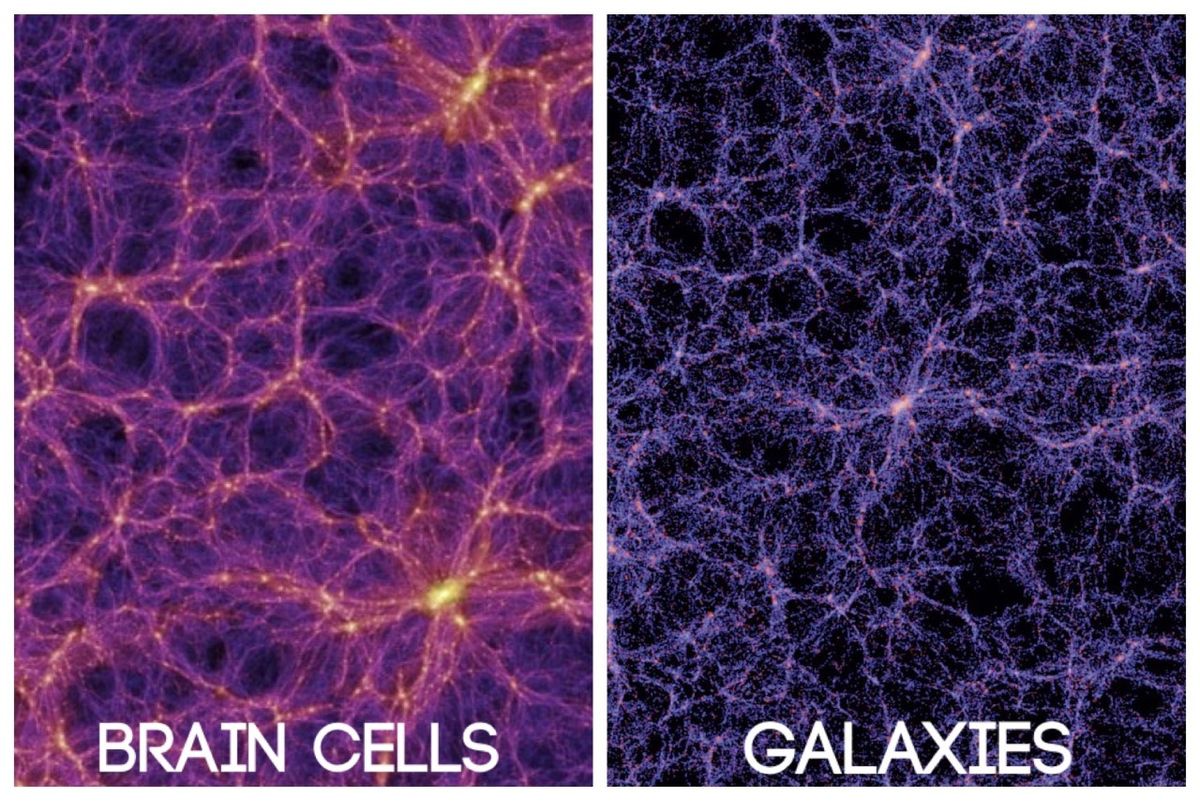
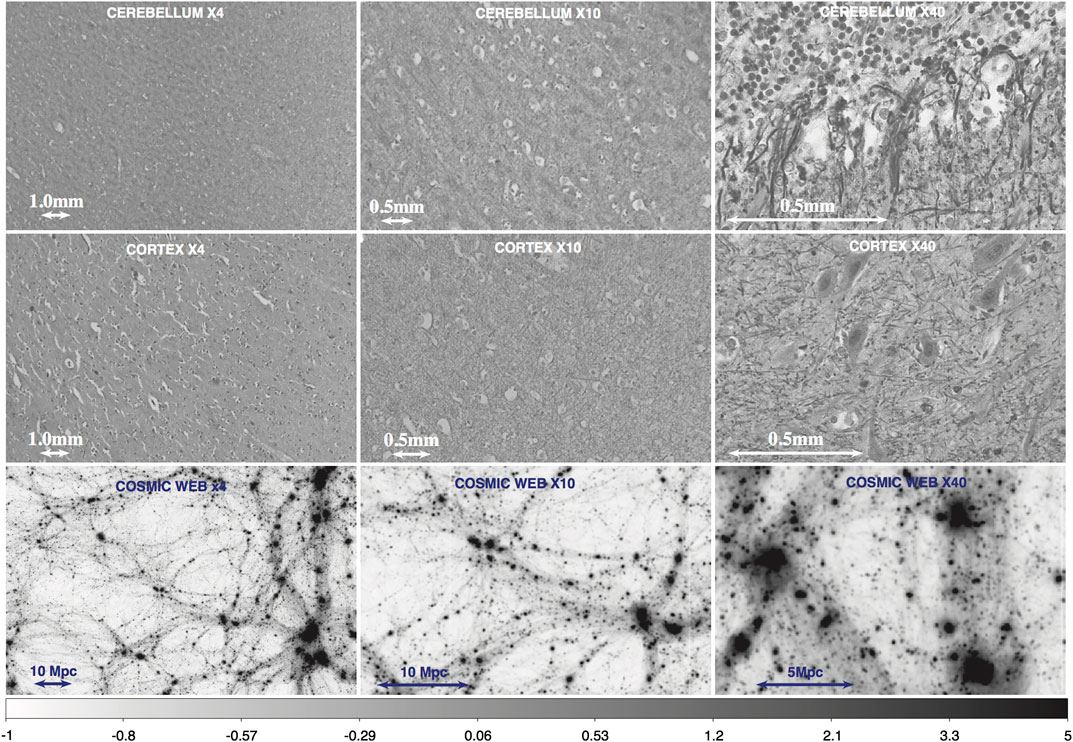
Imagine zooming in from the vast filamentary structures of the cosmic web to the branching dendrites of a single neuron, then further still to the turbulent, self-similar fluctuations of quantum foam at the Planck scale. These are not coincidences or superficial analogies. They are recurring signatures of deep organizational principles operating across vastly different scales, from the smallest quantum fluctuations to the largest cosmic structures.
|
|
[Figure 1: Cosmic web vs. neural connectome. Side-by-side comparison showing self-similarity and network connectivity.]
Classical Agnostic Deism holds that a creative principle or ultimate reality exists, but that its nature lies beyond human knowledge and requires no personal attributes, revelation, or intervention. It combines intellectual humility with a recognition of order in the cosmos. This essay extends that tradition by grounding it in empirical observation. Rather than relying on faith or metaphysical assertion, it draws inference directly from the observable architecture of reality itself.
The central thesis is this: The universe’s pervasive recurrence of scale-invariant patterns (self-similarity, criticality, emergence, network connectivity, and ignition-like thresholds) across cosmological, biological, physical, quantum-gravitational, string-theoretic, holographic, and computational domains constitutes inferential evidence for an underlying non-interventionist Architect: an elegant, mathematically encoded principle that orchestrates universal organizational rules without requiring direct revelation or personal attributes, thereby extending Agnostic Deism into a coherent, empirically grounded framework where the Architect is inferred solely from the observable architecture of reality itself.
This approach does not claim proof. It offers inference based on patterns that are repeatedly confirmed by data and theory. The essay proceeds from the largest scales to the smallest, showing how the same motifs reappear in cosmology, biology and Gaia, quantum foundations, quantum gravity (including loop quantum gravity, asymptotic safety, and causal set theory), string and M-theory, holography and tensor networks, and finally in human-engineered systems. Each domain reinforces the others, pointing toward a single, compact mathematical logic. The conclusion then explores the philosophical and ethical implications of Agnostic Deism.
By the end, the recurring patterns emerge not as isolated curiosities but as windows into a deeper architecture, inviting continued scientific curiosity and thoughtful stewardship rather than dogmatic closure.
II. The Universal Language: Core Patterns Across Scales
Beneath the apparent diversity of natural phenomena lies a surprisingly compact set of organizational principles that repeat across vastly different domains. Five motifs stand out with particular clarity: self-similarity (fractals), criticality (edge-of-chaos behavior), emergence, network connectivity, and ignition-like thresholds. Together, they function as a kind of universal mathematical signature, a recurring code that nature reuses at every scale, from the Planck length to the cosmic web. Their persistence is not trivial; it suggests a single underlying logic rather than a collection of unrelated accidents.
Key Motifs Summary
| Motif | Description | Example |
|---|---|---|
| Self-similarity | Fractal patterns statistically identical at different scales | Cosmic web, lung airways, quantum foam |
| Criticality | Systems poised at the edge of chaos | Neural avalanches, reservoir computing, SOC |
| Emergence | Higher-order structure arising from interactions | Spacetime from entanglement, Gaia homeostasis |
| Network Connectivity | Small-world / scale-free relational fabric | Cosmic web, tensor networks, spin foams |
| Ignition-like Thresholds | Sudden transitions launching new organization | Big Bang, neural ignition, Page curve |
Self-similarity appears as fractal geometry that looks statistically the same at different magnifications. The cosmic web of galaxies and dark matter filaments mirrors the branching patterns of neurons, lung airways, and river networks. In quantum gravity, spectral dimension running in loop quantum gravity, causal set theory, and asymptotic safety shows spacetime itself behaving fractally near the Planck scale (with effective dimension often dropping to 1.5-2.0) before flowing to classical four-dimensionality. Ecosystems display the same principle in forest canopies, coral structures, and soil pore networks. In each case, simple local rules generate complex, space-filling structures that optimize transport and resilience.
Criticality refers to systems poised at the edge between order and chaos, where small perturbations can trigger large-scale responses. Neural avalanches in the brain, the edge-of-chaos regime in reservoir computing, and the Page-time transition in black hole evaporation all exemplify this. Self-Organized Criticality (SOC), as demonstrated in Per Bak’s sandpile model, provides a general dynamical mechanism explaining why power-law avalanches and critical behavior appear so universally, from earthquakes and ecosystems to neural networks and quantum scars. Gaia’s climate and biogeochemical cycles hover near critical thresholds, as do quantum critical points in condensed matter and the UV fixed point in asymptotic safety. At criticality, systems achieve maximum computational power, information storage, and adaptability, a universal sweet spot that nature repeatedly occupies.
Emergence describes how robust macro-level behaviors arise from micro-level interactions in ways not obvious from the parts alone. Classical spacetime emerges from the fractal quantum foam and discrete causal sets. Consciousness emerges from neural criticality and connectivity. Planetary homeostasis (Gaia) emerges from local biological and geochemical feedbacks. In holography and tensor networks, bulk geometry and gravity emerge from boundary entanglement. In every instance, higher-order structure is not imposed from above but arises spontaneously through collective dynamics.
Network connectivity provides the relational fabric that makes emergence possible. The cosmic web, neural connectomes, spin foams, tensor networks (MERA and HaPPY codes), and Gaia’s biogeochemical cycles all exhibit small-world or scale-free topologies. Entanglement networks in holography and ER=EPR wormholes extend this pattern into quantum gravity. These networks are robust yet flexible, allowing information and influence to propagate efficiently across scales.
Ignition-like thresholds mark sudden, irreversible transitions that launch new levels of organization. Examples include the Big Bang and inflationary bubble nucleation, the zinc spark at fertilization, neural ignition underlying conscious awareness (central to theories such as Global Neuronal Workspace Theory and Integrated Information Theory), and the Page-time transition in black hole evaporation where the island appears and the Page curve turns. Each is a threshold-crossing event that bootstraps higher complexity from simpler precursors.
Why do these specific motifs recur so consistently? The repetition points to deep underlying mechanisms. Self-Organized Criticality (SOC) offers a general dynamical explanation for why systems naturally evolve toward critical states characterized by power-law avalanches. Renormalization-group flow further reveals universality classes: systems with wildly different microscopic details flow, under coarse-graining, toward the same macroscopic behavior and critical exponents. Together with the primacy of information and entanglement (Wheeler’s “It from Bit” and holographic principles), SOC and universality classes provide a candidate meta-mechanism, a compact set of rules that generate the same organizational signatures regardless of the underlying substrate. Eugene Wigner’s famous observation of the unreasonable effectiveness of mathematics highlights how the same abstract structures (fractals, power laws, renormalization-group flow) describe reality with surprising precision across unrelated domains. Modern holographic perspectives further suggest that information and entanglement may be more fundamental than spacetime itself. Together, these ideas indicate that the patterns are not accidental but arise from a single, compact informational and mathematical logic.
These universal motifs first become visible at the grandest scales.
III. Cosmological Patterns: The Macroscopic Architecture
At the largest observable scales, the universe reveals the same organizational principles that appear in quantum systems and living organisms (see Figure 2). The cosmic web, the vast network of galaxy clusters, filaments, walls, and voids, is not a random scattering of matter but a fractal-like structure shaped by gravitational instability acting on tiny primordial fluctuations.
[Figure 2: Fractal river network / Gaia feedback loop. Illustrates self-similarity and network connectivity at planetary and cosmic scales.]
Galaxy surveys and dark matter simulations show power-law clustering and self-similar behavior over hundreds of millions of light-years. The conditional density of galaxies follows Gamma(r) proportional to r raised to (D-3), where D is the fractal dimension (often measured between 1.2 and 2.5 at intermediate scales, with some studies reporting lower values around 1.2-1.6). Fractal cosmology models formalize this observation, treating matter distribution as statistically self-similar rather than strictly homogeneous. While mainstream cosmology assumes homogeneity beyond roughly 300 million light-years, fractal proponents argue that current surveys remain consistent with persistent self-similarity on larger scales.
This fractal architecture finds a natural theoretical home in eternal inflation. In this framework, quantum fluctuations prevent inflation from ending uniformly. Instead, regions continue inflating forever, nucleating bubble universes that form a self-reproducing fractal multiverse. Each bubble is an exponentially large domain with potentially different low-energy physics, embedded within an ever-growing inflating background. The global spacetime is therefore a never-ending fractal tree of bubbles, precisely the kind of hierarchical self-similarity seen in river networks or bronchial trees, now operating at the scale of entire universes. Our observable cosmos is simply one tiny pocket within this larger structure.
The holographic principle and renormalization-group flow provide an even deeper connection. According to holography, the information describing a volume of spacetime is fully encoded on its lower-dimensional boundary. In AdS/CFT duality, the radial direction in the higher-dimensional bulk corresponds exactly to energy-scale flow in the boundary theory. Renormalization-group coarse-graining thus links microscopic quantum details to macroscopic cosmic structure in a mathematically consistent way. The same flow that smooths quantum foam into classical spacetime also operates across the string landscape and eternal inflation, suggesting our universe is one effective description embedded in a larger informational architecture.
Of course, limits and open questions remain. Observations from the Planck satellite and large galaxy surveys indicate a transition toward homogeneity on the very largest scales, and fractal cosmology remains a minority view. Eternal inflation and the measure problem introduce technical challenges in assigning probabilities. These caveats are important; they remind us that the inference is provisional and grounded in evidence rather than absolute certainty.
Nevertheless, the macroscopic patterns are striking. Our universe displays fractal organization, self-reproducing hierarchies, and holographic encoding that strongly suggest it is not the ultimate level of reality but one node in a far grander, self-similar structure. The same motifs that govern quantum systems and biological life appear here at cosmic scales, pointing toward a unified architectural logic rather than disconnected coincidence.
Just as these patterns organize the cosmos at the largest scales, they also shape the architecture of life itself.
IV. Biological and Ecological Patterns: Life as Recursive Implementation
Life does not invent fundamentally new organizational strategies at each scale. It repeatedly deploys the same elegant rules that appear in quantum systems and cosmic structures. Nowhere is this more evident than in the fractal geometry that permeates living systems.
Fractal branching is ubiquitous. Lung airways, blood vessels, and neuronal dendrites all display self-similar branching with fractal dimensions typically between 1.5 and 2.7. Coral reefs, forest canopies, and river networks show comparable values (often 1.2-2.7), maximizing surface area for exchange while minimizing material and energy costs. These structures arise from simple recursive rules that optimize transport and resilience across scales.
Allometric scaling laws reveal the same underlying efficiency. The West-Brown-Enquist model derives Kleiber’s famous 3/4-power law (B proportional to M raised to 3/4, where B is metabolic rate and M is mass) from fractal resource-distribution networks. This quarter-power scaling governs heartbeat rates, lifespan, and growth across organisms from bacteria to whales. Lindenmayer systems (L-systems) provide a mathematical demonstration: simple recursive string-rewriting rules generate tree-like forms that mirror real plant morphology with remarkable fidelity. Minimal genetic information thus produces complex, space-filling fractal structures, a striking example of genetic efficiency.
Convergent evolution further underscores the fundamental nature of these rules. Across independent lineages, evolution repeatedly rediscovers similar fractal and optimal solutions, camera eyes in vertebrates and cephalopods, wings in birds, bats, and insects, branching architectures in plants and blood vessels, and even closed circulatory systems in diverse phyla. This parallelism strengthens the argument that the rules are not contingent but deeply embedded in the architecture of reality.
Ignition-like thresholds further illustrate the recursive logic. The zinc spark at fertilization, neural ignition underlying conscious awareness (central to theories such as Global Neuronal Workspace Theory and Integrated Information Theory), and collective behaviors such as bird flocking or ant colony organization all represent sudden, threshold-crossing transitions that bootstrap higher-order complexity. In these frameworks, criticality and ignition thresholds are not mere side effects but appear necessary for observers to exist: sufficient integration and global broadcasting of information only emerge when systems are poised at the critical boundary, allowing the transition from local processing to unified awareness. These events parallel the Big Bang and inflationary bubble nucleation at cosmic scales, showing nature’s repeated use of rapid, irreversible shifts to launch new levels of organization, including the emergence of observers themselves.
At the planetary scale, the Gaia hypothesis emerges as a natural extension. Earth’s biosphere, atmosphere, oceans, and geosphere function as a self-regulating system through fractal feedback networks. The plankton-DMS-cloud albedo loop, the carbonate-silicate thermostat, and global carbon-oxygen cycles operate as distributed, scale-spanning regulatory mechanisms. A MERA-style tensor-network model of Gaia would show local biological processes being coarse-grained into ecosystem layers and ultimately into planetary homeostasis, exactly as boundary entanglement builds bulk geometry in holography.
Inference: Biology and Gaia do not require special principles. They deploy the same elegant, mathematically encoded rules, fractal branching, allometric scaling, ignition thresholds, and network feedback, that govern quantum foam, tensor networks, and the cosmic web. Life is recursive implementation of the universal architecture, another local expression of the same self-similar logic. This consistency across scales strengthens the case for an underlying non-interventionist Architect whose principles enable complexity wherever the conditions align.
These same principles continue to operate at the smallest scales we can probe.
V. Physical and Quantum Foundations
The same organizational principles that shape galaxies and ecosystems already operate at the smallest scales we can probe. Renormalization-group (RG) flow provides the mathematical mechanism that links these levels. RG techniques systematically coarse-grain microscopic details into effective macroscopic laws, revealing universality classes where vastly different microscopic systems flow toward the same large-scale behavior. This is not an accident of approximation; it is a deep feature of nature that allows robust patterns to emerge despite enormous differences in underlying physics.
Quantum systems display explicit fractal geometry. The Hofstadter butterfly, the fractal energy spectrum of electrons in a magnetic field on a lattice, shows self-similar bands and gaps with a Hausdorff dimension around 1.8. In disordered systems, Anderson localization produces multifractal wavefunctions at the metal-insulator transition. Quantum many-body scars in Rydberg atom arrays and the PXP model exhibit non-ergodic, fractal-like revival dynamics embedded in otherwise chaotic spectra. These quantum fractals sit at critical points, echoing the edge-of-chaos criticality seen in neural networks and reservoir computing.
At the deepest scale, quantum foam, John Wheeler’s vision of spacetime at the Planck length, is inherently turbulent and self-similar. Virtual black holes, wormholes, and topology fluctuations create a frothy, fractal substrate where distance and causality become statistical averages. Modern approaches, including loop quantum gravity, causal set theory, and asymptotic safety, confirm this picture through spectral dimension running: spacetime behaves fractally (d_S approximately 1.5-2.0) near the Planck scale before flowing to the classical value of 4 at larger distances.
Inference: The same motifs, self-similarity, criticality, emergence, and network connectivity, already govern the microscopic ruleset. Quantum fractals and renormalization-group flow demonstrate that the universal language is written even at the Planck scale. Far from being isolated curiosities, these microscopic patterns form the foundation from which all larger structures arise. The architecture is consistent from the smallest fluctuations upward, pointing once more to a single, elegant, mathematically encoded principle.
This microscopic foundation becomes even clearer when we examine the frontier of quantum gravity.
VI. Fractal Spacetime in Quantum Gravity
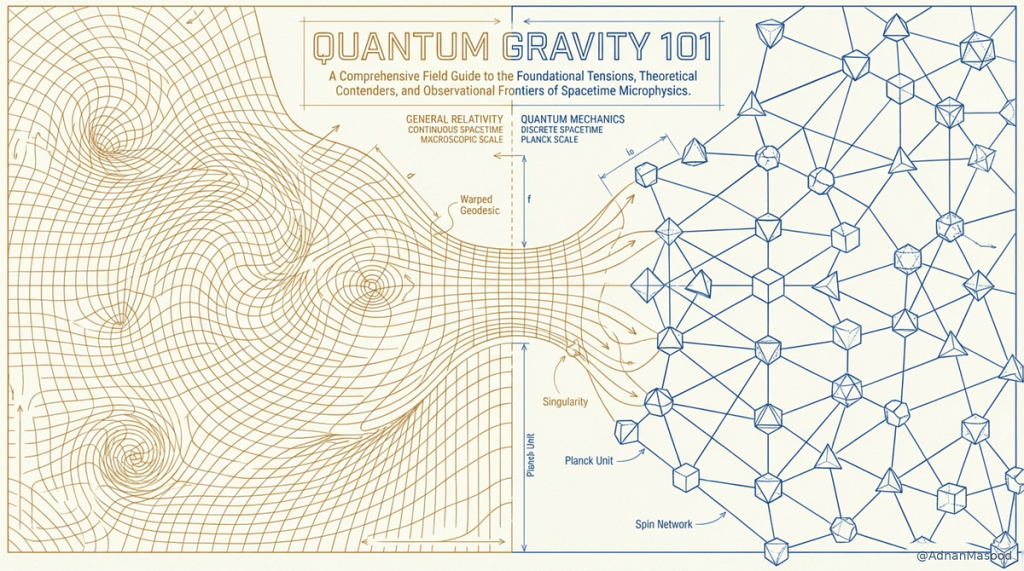
The microscopic ruleset revealed in quantum systems becomes even more striking when we examine the frontier of quantum gravity (see Figure 3). Multiple independent approaches converge on the conclusion that spacetime itself is fractal at the Planck scale, acquiring classical four-dimensional geometry only through coarse-graining.
[Figure 3: Spectral dimension running. Shows d_S flowing from approximately 1.5-2.0 at Planck scale to 4 at macroscopic distances, illustrating self-similarity and dimensional emergence.]
In Loop Quantum Gravity and closely related Causal Dynamical Triangulations (CDT), the spectral dimension, which measures how a random walker explores the quantum geometry, runs with scale. Near the Planck length, d_S approximately 1.5-2.0, indicating highly fractal, effectively two-dimensional behavior. It then rises smoothly, approaching the classical value of 4 at larger distances. This multifractal dimensional flow is a robust prediction shared across different truncations and numerical simulations.
Spin networks (the quantum states of geometry in LQG) and spin foams (their dynamical evolution) further exhibit fractal characteristics. Under renormalization-group coarse-graining, these discrete structures display self-similar branching and power-law statistics. The foam-like topology echoes Wheeler’s original quantum foam.
Asymptotic safety offers a complementary perspective. At its non-trivial ultraviolet fixed point, the gravitational RG flow produces a fractal UV regime with similar dimensional running. Spacetime is not fundamentally smooth but becomes effectively four-dimensional only after averaging over fractal quantum fluctuations.
Causal Set Theory provides a particularly clean discrete realization. Spacetime is modeled as a locally finite partially ordered set of elements with causal precedence. Simulations show clear fractal spectral dimension running (d_S approximately 2 near the Planck scale), self-similar growth dynamics, and fractal-like clustering under Poisson sprinkling. Classical 4D spacetime emerges naturally through coarse-graining of this underlying fractal discrete order.
Inference: This recurrence of the same five motifs at the quantum gravity scale provides further support for the central thesis. Quantum gravity itself is fractal at the deepest level. Classical smooth geometry is not fundamental but a coarse-grained manifestation of the same self-similar rules that operate everywhere else, from quantum foam and tensor networks to ecosystems and the cosmic web. The consistency of fractal dimensional flow and self-similar structures across Loop Quantum Gravity, Asymptotic Safety, and Causal Set Theory demonstrates that the universal mathematical language is written into the fabric of spacetime from the Planck scale upward. This microscopic foundation strengthens the case for an underlying non-interventionist Architect whose elegant, recursive principles generate the entire observable architecture through successive layers of emergence.
The same recursive logic extends to the level of possible universes themselves.
VII. The String Landscape and Fractal Multiverse
String theory and its non-perturbative completion, M-Theory, extend the fractal pattern to the level of possible universes themselves. The string landscape, the vast ensemble of possible vacua arising from different compactifications, fluxes, and brane configurations, is not uniformly distributed. Statistical scans reveal fractal clustering in moduli space, with self-similar nesting of vacua, power-law distributions of vacuum energies, and fractal-like boundaries separating the landscape from the swampland (theories that appear consistent at low energies but cannot be consistently coupled to quantum gravity). Swampland conjectures, especially the de Sitter and distance conjectures, further constrain the landscape, making it less arbitrary and more law-like by forbidding large classes of seemingly consistent effective theories.
When eternal inflation acts on this landscape, it produces a dynamically realized fractal multiverse. Quantum fluctuations perpetually drive different regions into different vacua, nucleating bubble universes that form a self-reproducing hierarchy. Each bubble is an exponentially large domain with potentially different low-energy physics, embedded within an ever-expanding inflating background. The global spacetime geometry is therefore a never-ending fractal tree of bubbles, the same self-similar, branching architecture seen in river networks, lung bronchioles, and tensor network layers, now operating at the scale of entire universes.
Even at more fundamental levels, string theory displays fractal behavior. Worldsheet dynamics in non-critical strings and Liouville theory can exhibit fractal geometry and multifractal scaling. The moduli spaces of Calabi-Yau manifolds used for compactification show self-similar structures under magnification, with mirror symmetry mapping one fractal-like geometry onto its dual. M-Theory inherits and extends this picture, incorporating higher-dimensional brane configurations whose intersections and stacks often form self-similar patterns.
Inference: This recurrence of the same five motifs at the string theory level provides further support for the central thesis. The string and M-theory landscape, together with the fractal multiverse generated through eternal inflation, follows the same recursive fractal logic that governs quantum foam, spin networks, ecosystems, and the cosmic web. Far from being arbitrary, the set of possible physical laws is structured by self-similar clustering and critical boundaries enforced by swampland conjectures. This level of mathematical consistency across the theory’s deepest predictions reinforces the inference of an elegant, non-interventionist Architect whose encoded principles operate uniformly from the Planck scale to the multiverse. The landscape is not a chaotic menu of possibilities but another clear manifestation of the universal architectural code.
These informational principles find their clearest expression in holography and tensor networks.
VIII. Holography and the Emergence of Spacetime
The holographic principle reveals that the distinction between inside and outside may be more subtle than classical intuition suggests (see Figures 4-6). In its most precise form, the AdS/CFT correspondence shows that a theory of quantum gravity in a higher-dimensional Anti-de Sitter spacetime is exactly equivalent to a conformal quantum field theory living on its lower-dimensional boundary. All bulk gravitational phenomena, including black holes and spacetime geometry, are fully encoded in the quantum entanglement patterns on the boundary. Spacetime itself emerges from entanglement.
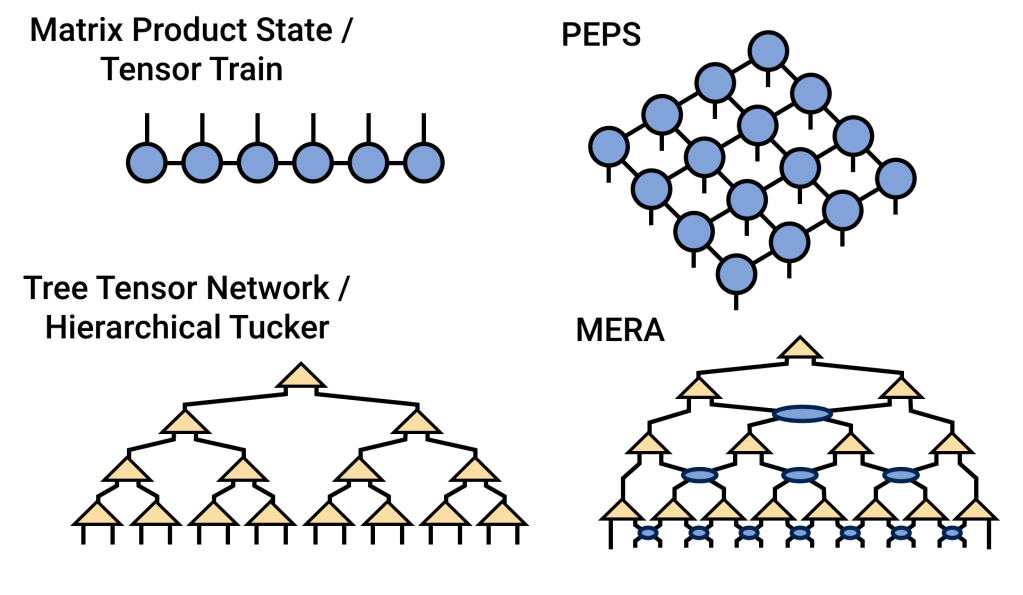
[Figure 4: MERA schematic. Layered tensor network demonstrating renormalization-group flow and emergence of bulk geometry from boundary entanglement.]
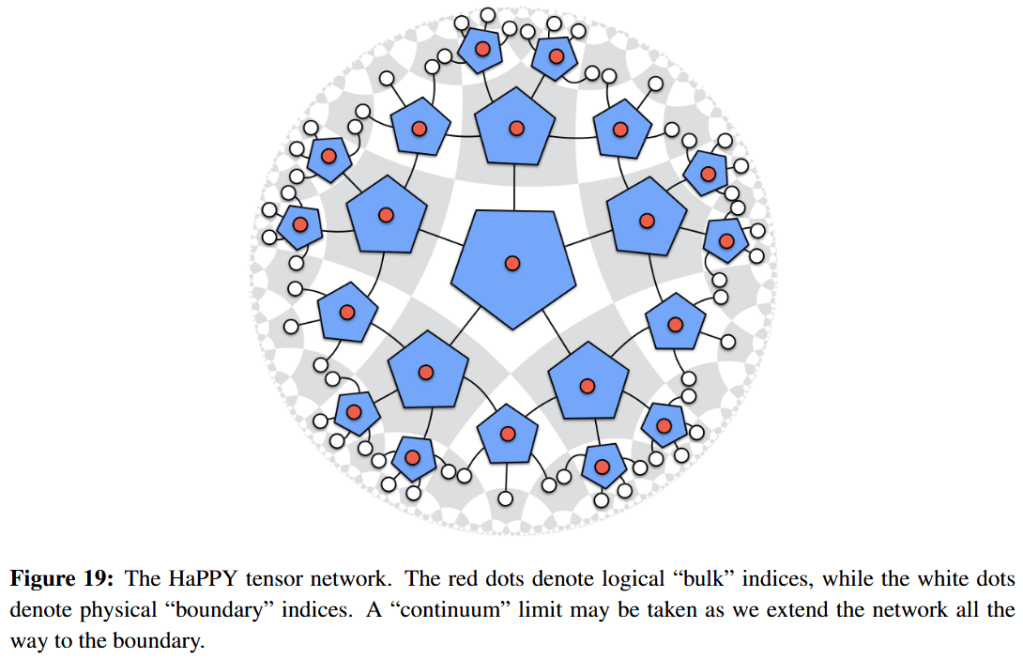
[Figure 5: HaPPY code tiling. Hyperbolic pentagonal lattice with perfect tensors illustrating network connectivity and compact encoding.]
|
|
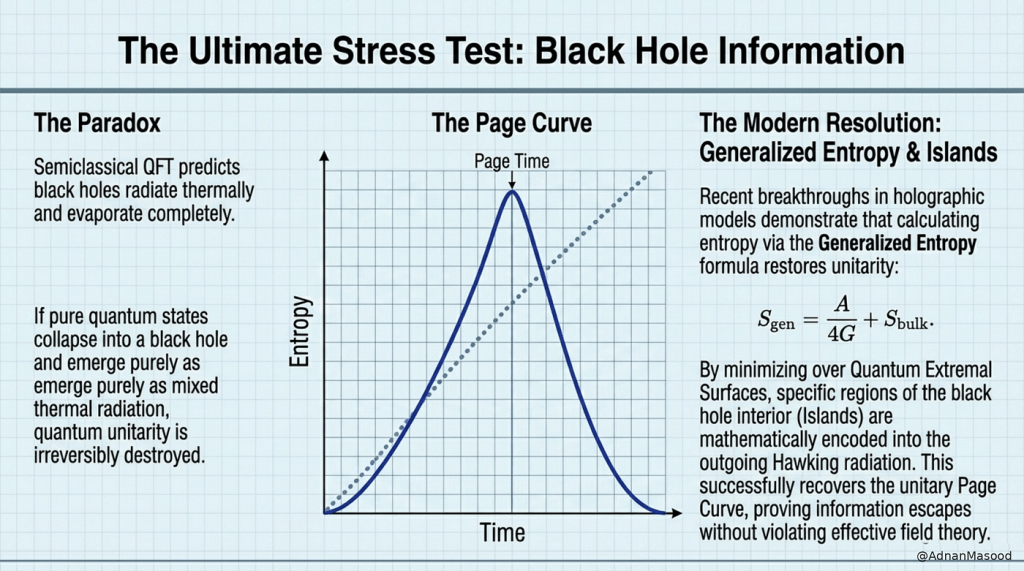
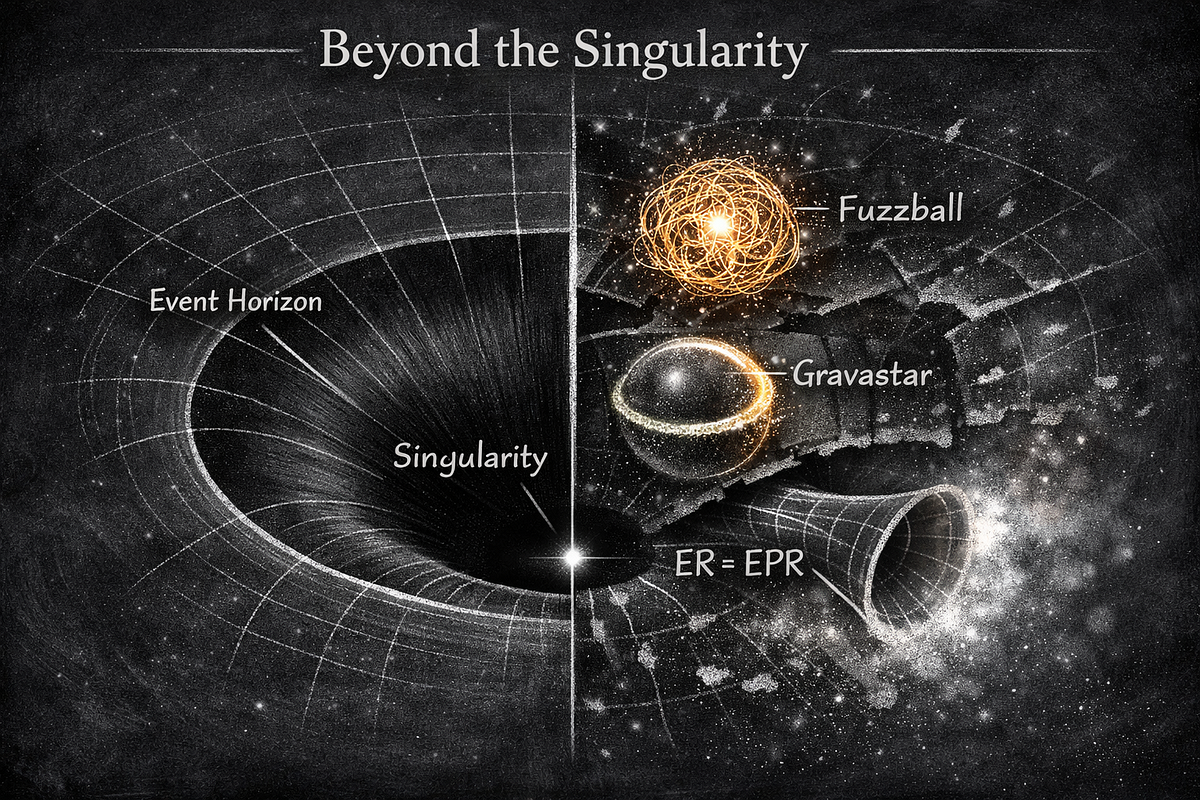
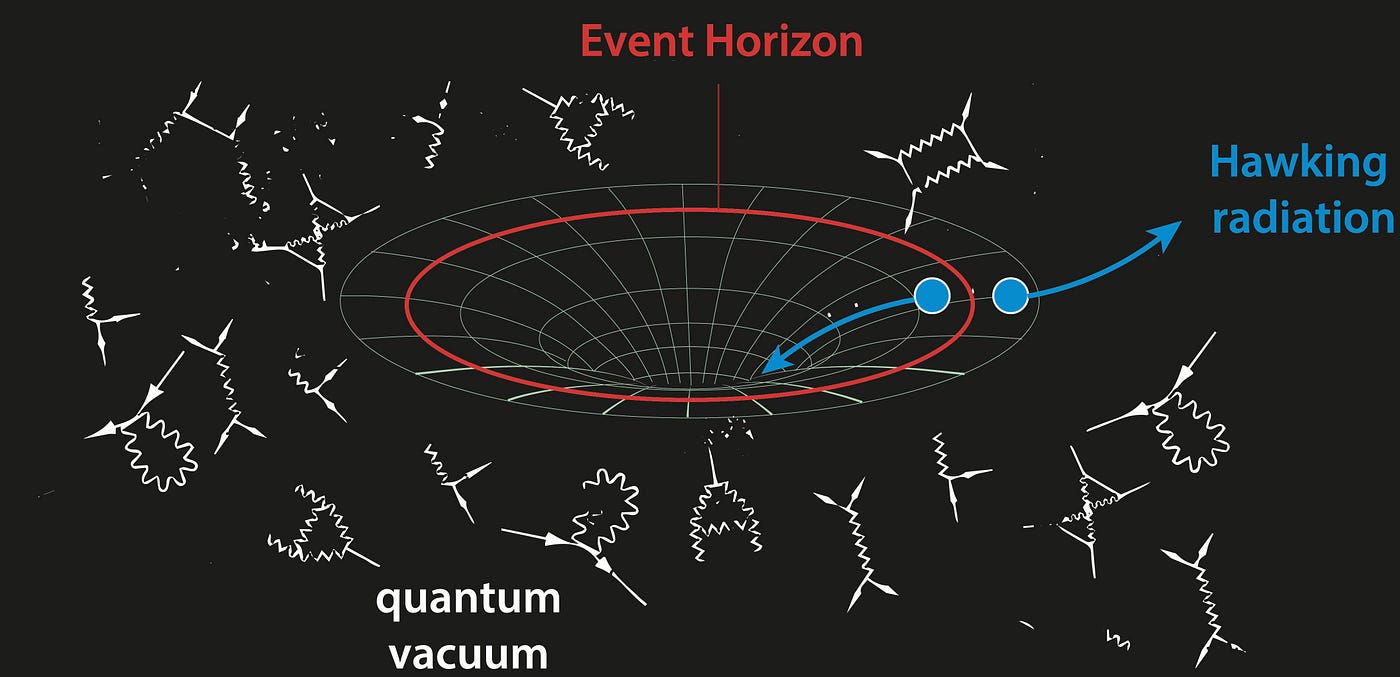
[Figure 6: Replica wormhole / fuzzball diagram. Visualizes the island proposal and horizonless microstates, highlighting ignition-like thresholds and information preservation.]
Tensor networks provide explicit, discrete realizations of this holographic encoding. The Multiscale Entanglement Renormalization Ansatz (MERA) uses layered disentanglers and isometries to implement renormalization-group flow, with the radial direction in the emergent bulk corresponding to energy scale on the boundary. The HaPPY code, built from perfect tensors on a hyperbolic pentagonal tiling, offers an even cleaner toy model with exact Ryu-Takayanagi entanglement entropy via minimal cuts and built-in quantum error correction. Hybrid constructions combining MERA’s explicit RG flow with perfect tensors achieve both strengths, showing how compact networks of entanglement can generate rich geometric structure.
These tools illuminate black hole physics with remarkable clarity. The ER=EPR conjecture identifies maximal entanglement with Einstein-Rosen wormholes, geometrizing quantum correlations. The island proposal and replica wormholes resolve the Page curve: after the Page time, a quantum extremal surface moves inside the horizon, enclosing an island whose entanglement purifies the radiation and restores unitarity without requiring a firewall. String theory fuzzballs complement this picture by replacing the classical horizon with a horizonless, stringy microstructure where information resides from the outset. Together, these approaches show that the apparent paradoxes of black holes dissolve once entanglement and microstructure are properly accounted for.
Inference: This recurrence of the same five motifs in holographic systems provides further support for the central thesis. Holography and tensor networks demonstrate the extraordinary compactness of the encoding rules. A lower-dimensional boundary of quantum information can fully describe an entire higher-dimensional gravitational spacetime. This same principle, compact encoding through entanglement and network connectivity, operates consistently from quantum foam to black hole microstates to the cosmic web. It is yet another powerful signature of the elegant, mathematically encoded architecture inferred throughout this essay. The universe does not require fundamental higher-dimensional geometry; it can be projected from deeper informational principles, reinforcing the case for a non-interventionist Architect whose logic is written in entanglement and recursion.
Human engineering independently rediscovers these same principles when building intelligent systems.
IX. Artificial and Computational Mirrors: Human Rediscovery
When humans set out to build systems capable of complex information processing and intelligence, we independently rediscover the same organizational principles that nature has used for billions of years. This convergence is one of the strongest indirect validations of the universal motifs.
Reservoir computing illustrates the point with striking clarity. In echo state networks and liquid state machines, performance peaks when the recurrent reservoir operates at the edge of chaos, the critical boundary between ordered decay and chaotic divergence. In this regime, inputs ignite sustained, scale-free avalanches of activity with power-law statistics, maximizing memory capacity, nonlinearity, and computational expressivity. Quantum reservoir computing extends the same principle into many-body quantum systems. These engineered systems deliberately tune themselves to the identical criticality that appears in neural avalanches, Gaia tipping points, and quantum critical phenomena.
Fractal structures also emerge naturally in artificial neural networks. Weight matrices, activation patterns, and loss landscapes frequently display self-similar boundaries and multifractal correlations. The boundaries between trainable and non-trainable hyperparameter regions often have organic, fractal geometry, while training dynamics exhibit power-law avalanche statistics reminiscent of biological neural networks and cosmic structure formation.
Fractal Art: Creative Expression of the Universal Code
One of the most direct and accessible human rediscoveries of these patterns appears in fractal art. Artists harness simple iterative equations, most famously the Mandelbrot set z_{n+1} = z_n^2 + c or flame fractals, to generate infinitely detailed, self-similar images that echo the cosmic web, neural branching, and quantum foam.
Pioneering artists include Scott Draves, whose Electric Sheep project creates evolving, collective fractal artworks through distributed computation; Hamid Naderi Yeganeh, who produces highly intricate mathematical images with thousands of iterations that reveal organic, almost biological forms; and Daniel White, developer of the Mandelbulb 3D renderer, whose bulbous, volumetric fractals resemble alien landscapes or microscopic life. Fractal landscapes often exhibit an uncanny naturalness, with mountains, clouds, and coastlines that are visually indistinguishable from real terrain. Beyond pure art, fractal algorithms are now routinely used in scientific visualization, for rendering quantum foam turbulence, cosmic web simulations, and complex biological structures, demonstrating the practical utility of these patterns in both discovery and communication.
Fractal art is not decoration. It is a participatory exploration of the Architect’s motifs. By rendering recursive rules into visual wonder, artists demonstrate how the same compact code that structures reality can evoke profound aesthetic and emotional responses. This human rediscovery reinforces the thesis: the patterns are so fundamental that we instinctively recognize and celebrate them when we encounter their mathematical expression.
Inference: This recurrence of the same five motifs in human-engineered systems provides further support for the central thesis. Human engineering does not invent new principles; it rediscovers the Architect’s motifs. Criticality for optimal computation, fractal scaling for efficient connectivity, emergence for higher-order function, and network topology for robust information flow all reappear when we optimize for intelligence and efficiency. Artificial systems serve as mirrors, confirming that the same elegant, mathematically encoded logic governing quantum foam, biological life, Gaia, and the cosmic web also underlies robust computation and artistic creation. In building intelligent machines and creating fractal art, we participate in and validate the universal architecture.
Taken together, these cross-domain patterns point compellingly toward a unified explanation.
X. Synthesis: From Patterns to Architect
Across the preceding sections, the same five motifs have reappeared with remarkable consistency: self-similarity (fractals), criticality (edge-of-chaos behavior), emergence, network connectivity, and ignition-like thresholds. Their quantitative alignment is particularly compelling and provides some of the strongest support for the central thesis.
The convergence is not merely qualitative. Specific mathematical signatures repeat across vastly different domains with measurable regularity. The table below summarizes key overlapping parameters:
| Signature | Typical Range / Value | Domains Showing the Signature | Shared Mathematical Role / Implication |
|---|---|---|---|
| Fractal Dimension | 1.2 – 2.7 | Cosmic web, lung airways, neurons, coral reefs, river networks, quantum gravity (spectral) | Efficient space-filling and transport optimization |
| Spectral Dimension (UV) | ~1.5 – 2.0 → flows to 4 | Loop Quantum Gravity, CDT, Asymptotic Safety, Causal Sets | Dimensional flow from fractal quantum regime to classical spacetime |
| Power-Law Exponent (τ) | ≈ 1 – 2 (avalanche statistics) | Neural avalanches, quantum scars, SOC sandpiles, ecosystems, string landscape vacua | Scale-free avalanche dynamics and criticality |
| Small-World / Scale-Free Networks | High clustering + short path lengths | Cosmic web, neural connectomes, spin foams, tensor networks, Gaia cycles | Optimal information propagation and robustness |
| Criticality / Ignition Threshold | Edge-of-chaos tuning; sharp phase transitions | Neural ignition, reservoir computing, Gaia tipping points, Page curve, inflationary transitions | Maximum computational power and sudden emergence of new organization |
These shared numerical fingerprints, fractal dimensions clustering in the same window, spectral dimension running following the same trajectory, power-law statistics with comparable exponents, and systems repeatedly tuned to criticality, are highly non-trivial. They appear in systems governed by completely different microscopic physics, from Planck-scale quantum geometry to planetary biogeochemical cycles to engineered neural networks.
Moreover, the same mathematical structures, fractals, power laws, renormalization-group flow, and criticality, describe reality with surprising precision across completely unrelated domains. As Eugene Wigner famously observed, this unreasonable effectiveness of mathematics is itself astonishing. Here it suggests not mere coincidence but evidence of a profound underlying order.
Self-Organized Criticality (SOC), exemplified by Per Bak’s sandpile model, further strengthens the mechanistic picture. SOC demonstrates how simple local rules naturally drive systems toward a critical state characterized by power-law avalanches, a general dynamical mechanism that explains why criticality appears so universally across neural networks, earthquakes, ecosystems, reservoir computing, and quantum scars. This provides a unifying dynamical explanation for why the patterns repeat so consistently.
Finally, modern holographic views, echoing Wheeler’s “It from Bit,” suggest that information and entanglement may be more fundamental than spacetime itself. In this light, the boundary in holography, the entanglement in ER=EPR, the tensor networks encoding bulk geometry, and even Gaia’s regulatory feedback loops all point to information as the primary substrate. The Architect thus appears less like a vague force and more like an informational principle from which spacetime and complexity emerge.
Many of these patterns also arise from symmetry principles and spontaneous symmetry breaking. Phase transitions, criticality, and emergence in quantum field theory, cosmology (e.g., inflationary symmetry breaking), and biology (e.g., symmetry in body plans) reflect the same foundational mathematical layer. A striking example is the emergence of Goldstone bosons (or Nambu-Goldstone modes) as massless particles arising from spontaneous symmetry breaking, providing a universal mechanism that links microscopic symmetry principles to macroscopic observable phenomena across scales. This thesis also aligns with structural realism in the philosophy of science: we can reliably infer the relational structure (the recurring patterns) even if we cannot know the ultimate nature of reality itself.
Addressing Counterarguments
Several important objections deserve careful consideration. One common challenge is the multiverse plus anthropic selection: we simply observe these patterns because we happen to inhabit a rare life-permitting pocket. Yet anthropic reasoning presupposes the very structured landscape, swampland boundaries, critical regimes, and fractal organization that themselves cry out for explanation. It shifts the question rather than answering it.
Another objection holds that the observed order is simply a brute fact or the result of pure coincidence. However, the simultaneous convergence of the same five mathematical motifs, with matching quantitative signatures, across entirely independent domains (quantum gravity, biology, cosmology, and computation) makes coincidence extraordinarily improbable. Even if each pattern could be explained in isolation, their repeated co-occurrence demands a unifying cause far more than a growing list of unrelated accidents.
Reductionist critics may argue that everything ultimately reduces to physics, rendering higher-level patterns epiphenomenal. This misses the deeper question: why does physics itself repeatedly employ the same compact organizational logic at every scale, from quantum foam to planetary regulation to cosmic structure? Reductionism explains the parts but fails to account for the striking recurrence of the architectural rules.
Some may worry about pattern-seeking bias, or apophenia, that we are merely imposing meaning on unrelated phenomena. Yet the patterns are not subjective interpretations; they are quantifiable (fractal dimensions 1.2-2.7, spectral dimension running approximately 1.5-2.0 to 4, power-law exponents tau approximately 1-2, criticality at phase transitions) and independently confirmed across multiple fields using different methodologies and data sets. The convergence is empirical, not anecdotal.
Finally, one might object that the inference is not directly testable. While a single decisive experiment may not exist, the framework does make falsifiable predictions. Future observations, higher-resolution cosmic surveys, quantum gravity simulations, and AI criticality studies, should continue to reveal the same motifs rather than arbitrary alternatives. Persistent confirmation would strengthen the case; systematic contradiction would weaken it.
In each instance, the single-principle explanation remains more parsimonious. Occam’s razor and Bayesian updating favor a unified, mathematically encoded architecture over a proliferating list of independent coincidences or ad-hoc rescues.
Strength of the Inference
This is not a deductive proof but a cumulative, Bayesian-style inference. Each domain supplies independent confirmation of the same compact mathematical architecture. When five distinct motifs converge quantitatively across quantum gravity, biology, cosmology, and computation, the probability of this occurring by chance under a model of multiple independent coincidences becomes vanishingly small. In contrast, a single elegant underlying principle explains the entire pattern with maximal parsimony. The likelihood ratio strongly favors a single underlying principle (P(data|single principle) much greater than P(data|multiple coincidences)). The cumulative evidence therefore shifts the Bayesian balance strongly toward a unified, mathematically encoded architecture, elevating the inference from compelling pattern recognition to a strong cumulative case.
This principle, the Architect, is inferred solely from the observable architecture of reality. It does not dictate specific outcomes but sets the compact rules within which complexity, observers, and self-regulation naturally emerge. The patterns do not prove intention or personality; they reveal an underlying logic that is consistent, recursive, and astonishingly efficient. In this way, the Agnostic Deism framework remains humble about what lies beyond the patterns while finding strong inferential support for the existence of an elegant architectural principle that governs the universe from the Planck scale to the multiverse.
Testability and Future Predictions
The Agnostic Deism framework is not only explanatory but also scientifically testable. It generates several falsifiable predictions:
- Higher-resolution cosmic surveys (e.g., next-generation CMB missions and large-scale structure telescopes) should continue to reveal persistent fractal scaling and power-law clustering on ever-larger scales rather than perfect homogeneity.
- Quantum gravity experiments and simulations (e.g., refined CDT/LQG calculations or future tabletop analogs) should consistently show spectral dimension running and fractal-like behavior near the Planck scale.
- AI systems optimized for robust intelligence and efficiency should spontaneously converge toward edge-of-chaos criticality and fractal-like internal structures, mirroring biological and quantum systems.
- Cross-disciplinary studies of complex systems (biology, climate, economics) should continue to uncover the same five motifs with matching quantitative signatures.
Persistent confirmation across these domains would strengthen the case; systematic absence or contradiction in new data would weaken it. This predictive power underscores that the framework is a genuine scientific-philosophical hypothesis rather than unfalsifiable metaphysics.
XI. Philosophical Extension of Agnostic Deism
This essay extends the Agnostic Deism framework by grounding it in observable, recurring patterns. The result preserves the core humility of Agnostic Deism while providing positive, evidence-based reasons to infer an underlying creative principle.
The Architect inferred by Agnostic Deism is fundamentally non-interventionist. It does not act through miracles, personal revelation, or direct moral commands. Instead, it manifests as an elegant, mathematically encoded set of organizational rules, self-similarity, criticality, emergence, network connectivity, and ignition-like thresholds, that operate consistently across all scales. This principle sets the compact framework within which complexity, life, and observers can arise, but it does not micromanage outcomes. The universe unfolds according to its own internal logic, not external decrees.
This view contrasts sharply with both classical theism and atheism. Classical theism typically posits a personal deity who intervenes in history, answers prayers, and reveals specific moral codes. The pattern-based Architect requires none of these attributes and remains silent on personality or intention. Atheism, on the other hand, often treats the observed order as brute fact or the result of pure chance within a multiverse. The recurring patterns across quantum gravity, string theory, biology, Gaia, and computation make such brute-fact explanations increasingly strained. The Agnostic Deism position sits productively between these poles: it affirms an inferred creative principle while maintaining deep epistemic humility about its further nature.
This thesis also aligns with structural realism in the philosophy of science: we can reliably infer the relational structure (the recurring patterns) even if we cannot know the ultimate nature of reality itself. The patterns provide robust epistemic access to the architecture without claiming full ontological knowledge.
Comparison with Alternative Worldviews
| Worldview | View of Order | Intervention / Personality | Basis of Inference | Relation to Patterns |
|---|---|---|---|---|
| Classical Theism | Created and sustained by personal God | High (miracles, revelation) | Revelation + design arguments | Patterns seen as deliberate acts |
| Atheism / Materialism | Brute fact or multiverse coincidence | None | Reductionism + chance | Patterns as accidental or emergent only |
| Pantheism | Universe itself is divine | Low to none | Mystical unity | Patterns identified with the divine |
| Agnostic Deism | Mathematically encoded non-interventionist principle | None | Observable recurring patterns | Patterns as direct evidence of the Architect |
Ethical Implications Across Scales
Because the Architect is expressed through the integrity of the patterns themselves, stewardship becomes a form of participation in the universal architecture. At the planetary scale, preserving Gaia’s fractal feedback networks, biodiversity, climate regulation, ocean chemistry, sustains one local expression of the code. At cosmic scales, responsible space exploration and orbital debris mitigation protect the larger cosmic web. At the quantum and informational level, careful stewardship of vacuum stability and long-term information preservation respects the foundational patterns. In artificial systems, designing neural networks and quantum reservoirs that align with natural criticality rather than opposing it honors the same principles. Stewardship of Gaia’s fractal networks is thus intimately linked to stewardship of quantum information and vacuum stability, a unified ethical arc spanning all scales.
Ultimately, Agnostic Deism transforms wonder into responsible action. We do not claim to know the Architect’s mind, but we can recognize and protect the elegant patterns through which the universe expresses its deepest logic. Humility and stewardship are not opposed but complementary: the more clearly we see the architecture, the more carefully we should tend it. The patterns invite us not to worship or dismiss, but to participate thoughtfully in the ongoing unfolding of reality.
XII. Conclusion
The universe’s pervasive recurrence of scale-invariant patterns, self-similarity, criticality, emergence, network connectivity, and ignition-like thresholds, across cosmological, biological, physical, quantum-gravitational, string-theoretic, holographic, and computational domains constitutes inferential evidence for an underlying non-interventionist Architect: an elegant, mathematically encoded principle that orchestrates universal organizational rules without requiring direct revelation or personal attributes, thereby extending Agnostic Deism into a coherent, empirically grounded framework where the Architect is inferred solely from the observable architecture of reality itself.
This extended framework builds a genuine bridge between science and philosophy. It does not substitute empirical rigor with faith, nor does it dismiss the profound order we observe as mere brute fact or cosmic accident. Instead, it takes the recurring patterns themselves, from quantum foam and spectral dimension running in quantum gravity to fractal ecosystems and Gaia’s regulatory networks, from holographic tensor networks and ER=EPR to the fractal multiverse of eternal inflation, as the clearest available evidence of a deeper, unified architectural logic. The same compact mathematical principles reappear at every scale, suggesting that reality is structured by elegant, recursive rules that enable complexity and observers without external intervention.
The consistency is striking. Fractal dimensions, power-law statistics, criticality at phase transitions, and network-driven emergence appear from the Planck scale to planetary homeostasis to cosmic structure. This is not a collection of disconnected curiosities but a coherent signature of a single underlying principle. While the inference remains provisional and open to revision, the cumulative weight of evidence across independent domains makes it difficult to dismiss as coincidence.
The exploration, therefore, does not end in dogmatic certainty or final closure. It ends in an open invitation. The patterns continue to unfold, from quantum foam to future observations of dark energy, from Gaia’s feedback loops to deeper insights in quantum gravity and artificial systems. Upcoming observations, such as next-generation CMB surveys, proposed quantum gravity experiments, and advancing studies of criticality in artificial intelligence, will further test and refine this inference. They call us to continued scientific curiosity, intellectual humility, and responsible stewardship of the architecture we inhabit, whether protecting fractal ecosystems and planetary regulation, preserving cosmic environments, or designing technologies that align with rather than oppose the universal motifs.
Implications for Other Fields
Beyond its philosophical value, this framework offers practical implications. In AI alignment, recognizing natural criticality and network motifs could guide the design of safer, more robust systems that align with the universe’s own organizational principles rather than fighting them. In climate modeling and synthetic biology, explicit attention to fractal feedback networks and self-organized criticality may improve predictions of tipping points and the engineering of resilient ecosystems. These applications demonstrate that the patterns are not only descriptive but actionable, inviting interdisciplinary collaboration grounded in the same elegant architecture.
Just as we began by zooming in from the cosmic web through neurons to quantum foam and witnessed the same patterns repeating at every level, we now see that the universe invites us to zoom back out with new understanding. The patterns are there. The journey of discovery remains open.
Selected References
- Ambjørn, J., Jurkiewicz, J., & Loll, R. Spectral dimension of the universe. Physical Review Letters, 2005.
- Bak, P. How Nature Works: The Science of Self-Organized Criticality, 1996.
- Brown, J. H. et al. (West-Brown-Enquist model papers on allometric scaling).
- Harlow, D. et al. HaPPY code and holographic tensor networks.
- Maldacena, J. The large N limit of superconformal field theories and supergravity (AdS/CFT), 1997.
- Wheeler, J. A. Information, physics, quantum: The search for links, 1989.
- Studies on cosmic web fractality (Sylos Labini, Pietronero) and swampland conjectures (Vafa et al.).


Leave a comment